RAMSEY CLARK
Tuesday, August 12, 2008
Ramsey Clark's Letter for Jeff Wood
RAMSEY CLARK
Monday, August 11, 2008
Washington Post: Texas's Disdain
THE STATE of Texas had an opportunity this week to display a victor's grace. Instead, it rebuffed pleas by the U.S. secretary of state and the U.S. attorney general for help in resolving an international dispute and in the process gave the back of its hand to the country and its obligations.
The issue involved two foreign nationals on Texas's death row. The leading case involved José Ernesto Medellín, a Mexican national whom the state executed Tuesday for his part in the 1993 gang rape and murder of two Texas girls. There is little doubt that Mr. Medellín was guilty: He confessed to the crimes just hours after his arrest, and his conviction was upheld by state and federal appeals courts. But Mr. Medellín, who spoke fluent English and had lived in the United States since he was a child, later challenged his conviction because Texas law enforcement officials failed to inform him of his right under the Vienna Convention for Consular Affairs to speak with the Mexican consulate. The state, which admitted the error, became the subject of a dispute with Mexico before the International Court of Justice, the judicial arm of the United Nations.
The ICJ found that Mr. Medellín and 50 other Mexican nationals on death row in the United States were entitled to "review and reconsideration" of their cases because of Vienna Convention violations. President Bush ordered Texas to comply, but the state balked, citing state laws that prevented reopening the matter. In March, the U.S. Supreme Court sided with Texas, concluding that the ICJ ruling was not binding domestically and that the president overstepped his bounds in trying to force the state's compliance. The court, however, acknowledged that the United States had breached its duties under the Vienna Convention. Justice John Paul Stevens, who was part of the majority, urged the state to voluntarily comply or to work toward a reasonable resolution so as to mend the breach. Instead, Texas set this week's execution date for Mr. Medellín, which all but foreclosed the possibility of a legislative or diplomatic solution. In refusing to give the federal government more time, Texas has now increased the possibility that foreign countries will not recognize in a robust way the rights of U.S. citizens detained abroad. Yesterday, Texas executed a second foreign national, Heliberto Chi, a Honduran whose lawyers made arguments about his lack of consular access.
Texas should be commended for agreeing to support federal court review for some of the other Mexican nationals on death row. The state must be held to that promise. And all states and municipalities must be conscientious in the future to ensure that foreign nationals are informed of their right to consular access.
Sunday, August 10, 2008
Ralph Nader on death penalty
Friday, August 08, 2008
Texas Man Who Didn't Kill to Be Executed
Texas is scheduled to put a man to death this month even though he never killed anyone, in what apparently would be the first execution of its kind in more than a decade.
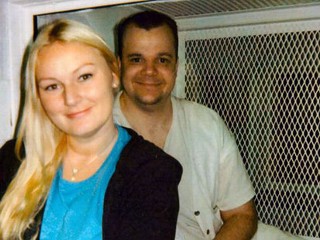
Texas death row inmate Jeff Wood and his wife Kristin. Wood is scheduled to be executed Aug. 21, even though he did not kill anyone.(Courtesy of Kristen Wood)Jeff Wood was sentenced to death in 1998 for his role in the murder of Kris Keeran, a gas station attendant who was killed during a 1996 robbery.
But Wood did not kill Keeran. Danny Reneau, Wood's former roommate, was convicted of shooting Keeran between the eyes during the robbery on Jan. 2, 1996. Reneau was executed in 2002.
Barring a last-minute commutation from the governor, Wood, 35, will be put to death on Aug. 21.
Wood was the getaway driver while Reneau robbed the Kerrvill, Texas, gas station where Keeran worked. Reneau shot and killed Keeran after he refused to go along with a plan to fake a robbery and split the proceeds, according to court documents.
Wood, who told police Keeran was a friend, later admitted that he came into the store after hearing the gunshot that killed Keeran, court opinions in the case say. Wood then helped Reneau take the store VCR and surveillance tapes -- he claimed only after Reneau forced him to do so at gunpoint.
Wood was convicted under a Texas law known as the law of parties, which makes Wood equally responsible for crimes committed by his accomplices that "should have been anticipated" during the course of the robbery -- even if he did not commit the crimes.
Though most states have similar laws, often called felony murder statutes, they are rarely used in death penalty cases. The last execution under a similar law was in 1996, in Oklahoma, according to the Death Penalty Information Center. There have been seven such executions, excluding murder-for-hire cases, since the death penalty was reinstated in 1976, according to the center.
Texas' law of parties statute is also broader than similar laws in most other states, said Robert Owen, director of the Capital Punishment Clinic at the University of Texas Law School.
"It's terribly risky to allow the death penalty to be imposed where the jury has to draw inferences about what was in the defendant's mind," said Owen. "There are serious questions about whether a getaway driver who might have anticipated that a death would take place should be death penalty eligible."
The U.S. Supreme Court has ruled that a person may be executed for a murder they did not commit or intend to commit if they were a "major participant" in the crime or acted with "reckless indifference to the value of human life."
Wood's appeals have been rejected by Texas and federal courts and he has appealed to the Texas board of pardons and Gov. Rick Perry for clemency. A spokeswoman for the pardons board declined to comment. It will review Wood's case Aug. 19 and make a recommendation to Perry.
One of the few death sentences Perry has commuted came last year in the case of Kenneth Foster, who was also sentenced to death for acting as a getaway driver during a robbery that ended in murder.Prosecutors in Wood's trial and appeals did not return calls for comment. Kerr County Assistant District Attorney Lucy Wilke, in a letter to the Texas Board of Pardons and Paroles, called Wood "the mastermind of this senseless murder," noting that Wood told his brother to destroy the surveillance tape after watching it together, according to the San Antonio Express.
After initially denying involvement in the robbery, Wood admitted in a statement to police that he knew Reneau was going to rob the gas station, that Reneau planned to bring a gun and might use it if Keeran didn't cooperate, according to court opinions.
Wood's family says the statement was coerced and point to testimony from a witness at Reneau's trial who said that Wood didn't know Reneau was bringing a gun. That testimony was not admitted at Wood's trial, according to his clemency petition.
His wife and father say Wood, who was initially found mentally incompetent to stand trial, is eager to please and has trouble understanding information.
"He had a very strong need to be accepted," his wife, Kristin, said. "He very easily went along with whoever wanted to accept him. That's why he ended up in bad company."
"He didn't know how to process information the way other people do," said Wood's father, Daniel. "He didn't know how to plan, he didn't know how to put things together. He loved to fish, but he couldn't plan for freshwater versus saltwater. His solution was to bring everything."
A jury found Wood guilty after deliberating for about 90 minutes. During the penalty phase of the trial, during which defense lawyers try to persuade the jury to spare the defendant's life, Wood told his lawyers not to call any witnesses or cross-examine any prosecution witnesses.
His trial lawyer said he was morally opposed to Wood's decision, calling it "a gesture of suicide," court papers say. Wood's clemency petition, filed earlier this week, called the penalty portion of the trial "a complete breakdown of the adversarial process."
Wood's family has organized a small grass-roots campaign to persuade the governor to spare his life. "He was always compassionate and involved with making things easier for other people," Daniel Wood said of his son. "He wanted to be important."
Heliberto Chi execution report from Huntsville, Texas
-Gloria Rubec
Will an unjust law claim another victim?
August 5, 2008
Texas activists celebrate after Kenneth Foster Jr. was given clemency hours before his scheduled execution (Matthew Beamesderfer | SW)
AT THIS time last year, the grassroots campaign to save Texas death row inmate Kenneth Foster Jr. was in full swing.
Kenneth had been sentenced to death in 1997 for driving the car Mauriceo Brown exited one night in 1996 to shoot and kill Michael LaHood Jr. He was convicted under the Texas Law of Parties, which allows prosecutors to treat those physically present at the scene of a murder as if they had pulled the trigger. Kenneth had no idea a murder was going to take place, yet he was tried alongside Brown for capital murder.
The Save Kenneth Foster Campaign won a steady stream of editorial support from Texas newspapers, and there was a palpable sense that our coalition of family and activists was having an impact. One month later, hours before Kenneth was to receive lethal injection for driving a car, we learned that Gov. Rick Perry, who presided over more executions than any governor in American history, was commuting Kenneth's sentence.
We won. Perry even expressed misgivings about a "Texas law that allows capital murder defendants to be tried simultaneously," adding, "it is an issue I think the legislature should examine."
In spite of Perry's reflections on that joyful day last August, Texas is again poised to execute a man who killed nobody.
Jeff Wood is slated to enter the death chamber on August 21, 2008 for the 1996 shooting death of a gas station clerk. Jeff sat in a car while another man, Daniel Reneau, entered a gas station and held up the attendant, Kris Keeran. According to the Save Jeff Wood Web site, when Keeran didn't move quickly enough, Reneau shot and killed him.
Hearing the shot, Jeff entered the gas station, saw Keeran's body and then discovered Reneau removing the gas station safe. According to the Web site, Reneau ordered Jeff at gunpoint to remove the surveillance tape and drive the getaway car. Jeff was also under the impression that the robbery--which had been planned for the day prior with the cooperation of station employees--had been called off.
- - - - - - - - - - - - - - - -
BUT WHO needs evidence when you can exploit a defendant's weaknesses? Jeff has a well-documented history of mental illness. Physically and emotionally abused as a child, Jeff's condition makes him vulnerable to aggressive behavior from others. Even during the planning stages of the robbery, Reneau threatened to kill Jeff's family if he didn't cooperate.
Police interrogated Jeff without counsel and kept him awake for hours until he issued a confession he would later recant. Though Jeff was initially found mentally unfit to stand trial and sent to a mental hospital, it took, according to the court system, only a couple of weeks for him to miraculously reverse a lifetime of mental illness and become "trial ready."
Jeff's court-appointed lawyer neglected to call any witnesses during the punishment phase of the trial. In fact, like nearly all inmates on death row in the U.S., Jeff is there, in large part, because he couldn't afford adequate representation.
Even members of Kris Keeran's family oppose Jeff's execution. Keeran's cousin, Amanda Smith, has said, "It's insane to kill another person who did not kill Kris." Keeran's father is a death penalty opponent who spoke out against Reneau's execution in 2006.
Inspired by last summer's victory in Kenneth Foster's case, Jeff's own family has taken a leading role in fighting his execution. Along with anti-death penalty groups like the Texas Moratorium Network, Texas Students Against the Death Penalty and the Campaign to End the Death Penalty, they are organizing rallies in San Antonio and Austin to get the word out. Jeff's supporters have also circulated a petition and initiated a letter drive to make the case for clemency.
Kenneth's case said a lot about the hypocritical core of the death penalty. We're told that capital punishment is reserved for the worst of the worst. Yet Kenneth was waiting to die for being in the wrong place at the wrong time.
We're also told that the death penalty is intended to protect vulnerable citizens from violent people. But in the Jeff Woods case, we see a system ready to exploit a mentally ill man's vulnerabilities in order to secure a conviction.
Last summer, we showed that we could stop an execution in the belly of the beast and make a right winger like Perry admit the truth about a particularly draconian law. Now it's time to make Perry live up to his words and stop the execution of Jeff Wood.
Thursday, August 07, 2008
Wednesday, August 06, 2008
Watch the Birds beat Texas with MD CASE

Lawrence Foster, Grandfather of Kenneth Foster, Jr. on Jeff Wood
Statement by the Council of Europe Secretary General Terry Davis
Execution in Texas: US should end its pick and choose attitude towards international law
Statement by Council of Europe Secretary General Terry Davis
Strasbourg, 06.08.2008 - “I am most concerned by the execution of Mexican national José Medellin yesterday in Texas. Mr Medellin was not informed of his right to consular help at the time of his arrest even though the United States are legally bound to guarantee this right under the 1963 Vienna Convention on Consular Relations. This is a regrettable attitude by a country which is very vocal about its commitment to the rule of law. The judicial authorities also blatantly ignored the order by the International Court of Justice to stay the execution on the grounds of the violation of the right to consular assistance. I wrote to the Texas Board of pardons and paroles in July, asking for a stay of the execution, but my appeal has been disregarded in the same way as the calls from the Mexican government, the UN Secretary General and several other governments and international organisations.
The issue at stake is not the guilt of Mr Medellin. He was found guilty of a particularly gruesome crime and he deserved to be punished.
The problem is the death penalty, which is rejected by a great majority of democratic and civilised countries across the world and also the pick and choose attitude of the United States of America – and its individual states - when it comes to respecting international law. The execution of Mr Medellin was therefore not only a violation of human rights and human dignity, but also an act of arrogant defiance which undermines the collective mechanisms for peace and security in the world.”
Council of Europe Press Division
Tel: +33 (0)3 88 41 25 60
Fax:+33 (0)3 88 41 39 11
pressunit@coe.int
www.coe.int/press
Kids Against the Death Penalty for Jeff Wood
http://www.savejeffwood.com
Medellin execution report from Huntsville
Tuesday, August 05, 2008
Texas executed Jose Medellin
HOUSTON — In a case that has drawn international attention, Texas executed José E. Medellín on Tuesday night in defiance of an international court ruling and despite pleas from the Bush administration for a new hearing.
The execution came just before 10 p.m. Central time, shortly after the United States Supreme Court denied a last request for a reprieve. Protesters for and against the death penalty clamored in the rain outside the Huntsville Unit, about 70 miles north of Houston, where Mr. Medellín was executed by lethal injection.
“I’m sorry my actions caused you pain,” he said to the witnesses present. “I hope this brings you the closure that you seek. Never harbor hate.”
Gov. Rick Perry, a Republican, rejected calls from Mexico and Washington to delay the execution, citing the torture, rape and strangulation of two teenage girls in Houston 15 years ago as just cause for the death penalty.
Mr. Medellín and five other teenage boys in his street gang took part in the rape and murder of the girls, Elizabeth Pena, 16, and Jennifer Ertman, 14. The gang raped the girls for an hour, then strangled them. Their corpses were found two days later.
Two other members of the gang were also sentenced to die. Two had their sentences commuted to life in prison. The sixth, Mr. Medellín’s brother, Vernacio, is serving a 40-year sentence.
Mr. Medellín’s case has become the focal point of a dispute between Mexico and the United States over whether some Mexicans have been denied fair trials because they were never given an opportunity to talk to a consul. A 1963 treaty requires foreigners accused of crimes to be given that opportunity.
Over the last five days, Mr. Medellín’s lawyers tried to stop the execution by arguing to the Supreme Court that it should be put off until Congress had a chance to pass pending legislation that would require a review of similar cases. They argued that Mr. Medellín would be deprived of life without due process if he died before Congress acted.
But the court, in a 5-to-4 decision, said the possibility of Congressional action was too remote to justify a stay. Justice Stephen G. Breyer wrote in dissent that to permit the execution would place the United States “irremediably in violation of international law and breaks our treaty promises.”
Mexico opposes the death penalty and has used the Vienna Convention on Consular Relations to try to block the executions of Mr. Medellín and 50 other Mexicans in the United States. Moments after the execution, Mexico sent a formal diplomatic protest to Washington.
Twice in the last five years, the International Court of Justice, at the Hague, has said hearings should be held to determine if the 51 trials were fair.
Worried about fallout for Americans abroad, the State Department, the attorney general and the White House all urged Texas to delay the execution.
Joan Baez - Prison Trilogy aka Three Stories
Monday, August 04, 2008
Texas Injustice: Family Members Speak Out
MonkeyWrench Books, 110 E. North Loop Blvd.
Family members of death row inmates tell their stories about the criminal injustice system. Featuring Sandra Reed, mother of Rodney Reed, innocent on death row; Lawrence Foster, grandfather of Kenneth Foster Jr., who came within hours of an execution before winning a commutation of his sentence; Jeannine Scott, wife of wrongly convicted Yogurt Shop defendant, Michael Scott; and Delia Perez Meyer, sister of falsely accused death row inmate, Louis Castro Perez.
This event is part of a series of events sponsored by MonkeyWrench Books called Beyond the Bars: Local struggles against the Prison Industrial Complex. During the weekend of September 26-28, Oakland, California will play host to Critical Resistance 10, celebrating a decade of struggle against the Prison Industrial Complex. In the month before Critical Resistance, Monkeywrench Books will be hosting a series of prison-related events every Monday in August, featuring films, local organizations, and individuals directly affected by the prison industrial complex. For more information visit monkeywrenchbooks.org.
Sunday, August 03, 2008
Express News: Inmate's supporters appeal to governor
Supporters of Texas inmate Jeffrey Wood, scheduled to die Aug. 21 for the 1996 murder of a Kerrville convenience store clerk, are hoping Gov. Rick Perry can see how similar Wood's case is to that of an inmate whose death sentence he commuted to life in prison last year.
“It was the exact same thing,” said Wood's wife, Kristin. “He has faith, especially that the truth will come out eventually.”
Jeffrey Wood and his former roommate Daniel Reneau were convicted of murdering Kris Keeran, a clerk at the Kerrville Gold Star Texaco.
According to court testimony, Reneau held up the store . on Jan. 2, 1996, and shot Keeran after he refused to participate in a plan to stage a robbery and split the proceeds. Wood drove the getaway car. In a taped interview with a Kerrville police detective, Wood called Keeran “a real good friend.”
Wood's defense team claimed he was unaware that a robbery, let alone murder, would occur.
Kerr County Assistant District Attorney Lucy Wilke, formerly Lucy Cavazos, won a conviction against Wood under the law of parties statute, which makes someone who participates in an act that leads to homicide as culpable as the actual killer.
In a letter sent in July to the Texas Board of Pardons and Paroles, Wilke wrote, “Mr. Wood was the mastermind of this senseless murder. It was Wood who showed his teenage brother the surveillance video tape depicting the murder, while laughing, and then ordered his brother to destroy the tape.”
On Saturday, about 20 people gathered in front of the Alamo to rally for Wood's life, begging Perry for help.
Last August, Perry commuted a death sentence to life in prison for inmate Kenneth Foster Jr., also convicted under the law of parties statute.
“Jeff's case is so much like Kenneth's case; it is like a mirror image,” Lawrence Foster, grandfather of Kenneth Foster Jr., wrote in a statement read at the rally. “I remember thinking last summer that Texas had already executed the killer and yet they wanted Kenneth. It is the same for Jeff.”
The cases are so similar that Norway native Kristin Wood, 29, has found comfort and support from the Foster camp, including from Foster's wife, Tasha, a 24-year-old Netherlands citizen.
Wood's relatives staged the rally with the Texas Moratorium Network, which wants a two-year moratorium on all death penalty cases. A second rally for Wood is planned for Aug. 16 in Austin.
Meanwhile, younger relatives have joined a group called Kids Against the Death Penalty.
“I'm here because Jeff Wood is innocent and on death row for a murder that he didn't commit,” said Gavin Been, 11, Wood's nephew.
According to the Texas Moratorium Network, attorney Jared Tyler with the Texas Defender Service is preparing a clemency package to submit on Wood's behalf.
The victim's father, Charles Keeran, also would like to see Wood live.
“The death penalty, to me, is the easy way out,” he said. “If you had to be down there and get up every morning, as hot and humid as it is, knowing that you are going to spend the rest of your life locked up under those conditions, that's punishment. That's what I think my son would want for him.”
Wednesday, July 30, 2008
Austin Chronicle: Should Have Been Anticipated
Should Have Been Anticipated
Scheduled for execution Aug. 21: Jeffrey Wood
Jeffrey Wood did not enter the Gold Star Texaco in Kerrville until after he heard the gunshots.
He was sitting in a pickup truck parked outside the gas station – almost a second home to him, his sister Terri Been says, a real hangout where Wood often went to socialize with friends who worked there, including clerk Kris Keeran – when he heard gunfire. He ran inside, where he found his friend Keeran slumped over near the counter, dead from a single .22-caliber round that caught him between his left eye and the bridge of his nose. Holding the gun was another friend, Danny Reneau. Wood was shocked. Reneau pointed the gun at Wood and barked an order for him to grab a video surveillance camera and VCR. Wood was afraid, he later told police, and did as he was told. Reneau removed the store safe and the pair fled to the home of Wood's brother in Devine.
Wood did not fire the fatal shot and did not participate in the robbery that preceded the Jan. 2, 1996, murder. Nonetheless, Wood was sentenced to die, based on the state's "law of parties," also known as the "conspirator liability" statute. The law provides that if two or more people agree to commit one crime but in the process commit another, each person is guilty of the crime committed – if the crime was "one that should have been anticipated." This is a more nebulous form of traditional accomplice liability (aiding and abetting) that requires the state to prove specific, individual culpability. The difference here is in intent and foresight: Accomplice liability requires intent; conspiracy requires only a finding that the crime was foreseeable.
In Wood's case, the state argued that he had planned with Reneau to rob the Texaco and therefore was responsible for Keeran's death. But it isn't at all clear that Wood was planning to rob the store. Wood told police that he'd heard Reneau talking with someone else (the store manager, Been says) about a possible robbery – the place had taken in $17,000 over Christmas, and the pair speculated that a similarly hefty stash could be expected just after New Year's Eve, since the bank holiday would mean the money would not yet have been deposited – but Wood also said he believed the talk was "bullshit in the breeze." (Family members have said that Wood did initially talk about robbing the store, along with Reneau, the store manager, and Keeran, but insisted that Wood, Keeran, and the manager all dismissed the idea.)
Critics have argued that Texas' use of the law of parties unconstitutionally broadens the field of death-eligible defendants; the death penalty, they argue, should be reserved for the most culpable and most heinous crimes. In fact, Texas is the only state that uses a conspiracy statute to make defendants eligible for the death penalty. "To pass constitutional scrutiny," Wood's attorney Scott Sullivan argued on appeal, "a sentencing statute must not only narrow the class of persons eligible for the death penalty, it must also ensure sentencing decisions are based upon an individual inquiry" of culpability. Texas' law of parties fails to do that, he wrote. The state, however, argues that the law of parties is not implicated in a decision to impose death: "The Texas capital murder scheme does not allow an individual to be put to death merely for being a party because the law-of-parties cannot be applied in answering the special issues" that jurors must answer, argued then-Bexar Co. Assistant District Attorney Lucy Cavazos. A death sentence is assessed only if jurors find that a defendant would pose a continuing threat to society and that there is no mitigating evidence that might lessen the defendant's culpability. Yet Cavazos' argument evades the fact that without the law-of-parties, defendants like Wood wouldn't be eligible for death in the first place. The courts have sided with the state.
Wood's case is similar to that of Kenneth Foster, who was sentenced to death for the 1996 murder of Michael LaHood by a companion, based on the Bexar Co. district attorney's use of the conspiracy statute. Foster was scheduled to die last year but was spared when Gov. Rick Perry accepted the recommendation of the Board of Pardons and Paroles and commuted his sentence to life in prison. "I believe the right and just decision is to commute Foster's sentence," he said. Perry did not directly implicate the law of parties in explaining his decision but did raise the issue of culpability, saying he was "concerned" that state law allowed Foster to be tried jointly with triggerman Maurecio Brown.
Given the parallels between the Wood and Foster cases, Wood's supporters question how the state can execute Wood without further damaging the credibility of the Texas death system. (Indeed, Wood's sister, Been, argues that her brother is even less culpable of murder than was Foster.) "There will be a full package going to the governor, and I think you will see a lot of similarities between us and Foster," Sullivan said last week.
Wood's family and supporters also question whether Wood is actually competent to face execution. He was originally found incompetent to stand trial, because he could not adequately work with his attorneys and participate in his defense. During the sentencing phase, District Judge Stephen Ables ruled that Wood would not be allowed to fire his court-appointed lawyers and represent himself. Nonetheless, Wood would not allow his attorneys to present mitigating evidence – including evidence that Wood was abused as a child and had been diagnosed with serious learning disabilities. Moreover, school records show that Wood's maturity was notably retarded – school officials noted that although he looked his age, he behaved like a child, constantly sought approval for actions, and was easily led and influenced by others. The evidence further erodes Wood's culpability, Been argues. "Jeff was just dumb. He's so trusting of people and has to get burned in order to learn a lesson," she says. "He doesn't deserve to die."
Hickman: Texas needs to start a dialogue on the death penalty
In the early 1990s, I started correspondence with a man on death row. After a few years of writing, I went to visit him in person.
What I experienced shocked me. Thinking I was going in to see an angry human being, I met an intelligent person who seemed broken. Someone who had lived an abused, unloved life had lived the only way he knew how: in survival mode. His lifestyle was far from mine, but his upbringing was like nothing I could imagine, either. Leaving the prison, I was completely struck with the thought that people do what they know. While in his early twenties, uneducated, drugged up, and jobless, he had struck out and viciously murdered an innocent woman, had spent 20 years on death row, and still had no understanding of what it meant to be "productive" or a part of society. He had killed out of revenge for the murder of his best friend. Kill or be killed. That is what he knew. Several years later after our meeting, he was executed by the state, in each of our names.
As a society, without a doubt, we can agree that murdering a fellow human being is a horrendous act. It stains the perpetrator, or even an entire country, for life, for all time. So, here in Texas, we have the death penalty to terminate the life of the guilty who have taken a life.
But how does killing anyone, whether someone is in a crazed state who murders or a state sanctioned killing occurs, ever solve anything? Murdered, or put to death, left behind are grieving family members, children without parents, loved ones and friends all caught in the never ending questions of, "Why? What was solved? Will this heartache ever end?" And what about those we execute who are innocent? The greatest example, here, is Jesus Christ. Or Bruno Richard Hauptmann. The list goes on.
As a mom and a musician, I wanted to start a dialogue about the death penalty. Because I live in Texas, the state with the greatest number of executions, I wanted to get people to think about what the death penalty means: spiritually, economically, and morally. My hope was to start a dialogue that was open to all in the spirit of healthy debate and information—-a forum where people who were opposed to or for or conflicted by the death penalty could meet and discuss the issue without fear or hostility.
So, last spring, I had a meeting with the Texas Coalition to Abolish the Death Penalty (TCADP) here in my home.
We discussed ways to raise awareness, and I suggested a series of monthly concerts around the state of Texas, starting in Austin and ending in
Austin, going to 11 cities along the way. We decided to include musicians and speakers. In October 2007 we had our first event with Linda White, mother of a young woman who was murdered by two teenage boys and reverends John McMullen (First United Methodist Church) and Bobbi Kaye Jones (St. Johns United Methodist). Barbara Kooyman (Timbuk 3) was our first guest musician.
Since then, we have traveled to Huntsville, Corpus Christi, San Antonio, Houston, San Angelo, Beaumont, El Paso, and Denton.
Attendees have heard comments from a variety of speakers including El Paso Mayor John Cook (who has joined our tour, singing and speaking and challenging other Texas mayors to come out to the events), the amazing account of Rev. Carroll Pickett (the death row minister who witnessed 95 executions in Huntsville; he is convinced that at least 15 of those men were innocent), prosecutor Sam Millsap, victim's families talking about why they are opposed to the death penalty and listened to the music as diverse as Shelley King to Austin Lounge Lizards (who will be at our Waco event on Sept. 18) and Kinky Friedman, who will be at our Antone's finale October 1.
My hope is twofold: that you will come out and join in on this conversation, and that in five years we will have a moratorium on the death penalty here in Texas. Please, come express your opinions at one of the events and meet family members of murder victims, meet family members of those executed on death row. Come hear music and get involved at the same time. This isn't easy. In fact, it's intense.
To end with a thought, when Cain murdered Abel in the old testement, God didn't destroy Cain. He banished him, yes, but he set him out in the world marked with protection that no one would harm a hair on his head. Why would God do such a thing? I challenge you to start the dialogue.
Media Advisory - Save Jeff Wood from the Texas Executioner
For immediate release: July 29, 2008
Contacts:
Terri Been B.S., M. Ed, Sister of Jeff Wood
mystrus@hotmail.com
254-371-5650
Scott Cobb, President
Texas Moratorium Network
512-689-1544
scottcobb99@gmail.com
Kristin Wood, Wife of Jeff Wood
936-259-2182
kristinoftebro@gmail.com
Scott Sullivan
Jeff Wood's Attorney
210-227-6000
Rally to Save Jeff Wood From Execution to be Held in San Antonio August 2 at Noon
A rally for Jeff Wood, who is waiting to die on Texas Death Row with an execution date of August 21st, 2008, will take place in San Antonio in front of the Alamo at noon on Saturday, August 2. Wood was sentenced to death under the 'Law of Parties' for a murder he did not commit. The actual murderer was Daniel Reneau, who has already been executed by the state of Texas. Wood did not kill anyone and did not intend anyone to be killed. He did not know that Reneau would commit a murder.
What: 'Save Jeff Wood' rally to stop the execution and urge clemency for Jeff Wood
Where: In front of The Alamo at 300 Alamo Plaza, San Antonio, Texas
When: Noon on Saturday August 2
Speakers Include: Terri Been, sister of Jeff Wood; Kristin Wood, wife of Wood; representatives of Texas Moratorium Network, Texas Students Against the Death Penalty, Texas Death Penalty Abolition Movement, Campaign to End the Death Penalty and others.
Last summer, Governor Perry commuted the death sentence of Kenneth Foster only hours before he was scheduled for execution. The Board of Pardons and Paroles had voted the day before to recommend clemency for Foster, who had been convicted under the 'Law of Parties' even though he did not kill anyone. Many newspapers wrote editorials urging Perry to commute Foster's death sentence, including the Dallas Morning News, which wrote in , 'Not a Killer: Kenneth Foster does not deserve execution':
'Ours is the only state in the country to apply the 'law of parties' to capital cases, allowing accomplices to pay the ultimate penalty for a murder committed by another. Mr. Foster is a criminal. But he should not be put to death for a murder committed by someone else'
Now, Texas is set to execute another person who did not kill anyone but was sentenced to death under the Law of Parties.
The Coalition to Save Jeff Wood is asking the people of Texas to contact the governor and the Board of Pardons and Paroles and urge them to grant clemency to Jeff Wood, because he did not kill anyone. 'Many Texans support the death penalty, but I do not believe that any reasonable person in Texas believes that a person like Jeff Wood should be executed who did not kill or intend to kill. Wood's sentence should be commuted just as Kenneth Foster's was commuted', said Scott Cobb of Texas Moratorium Network.
The cousin of Kris Keeran (the murder victim) wants to save the life of Jeff Wood.
"My cousin was the person killed by Danny, not Jeff. I say this as a family member who realized long ago Jeff had no part in my cousin's murder and he shouldn't be executed. It's insane to kill another person who did not kill Kris. The video showed Jeff took no part in it. Jeff was one of my friends growing up and someone I think deserves a chance. If he didn't kill him, why should we kill Jeff? This is ridiculous."Everyone - including law enforcement and prosecutors alike - agree that Jeffrey Wood did not kill anyone during the January 2, 1996 incident for which he was sentenced to death. The undisputed facts are that Kris Keeran was shot and killed by Daniel Reneau. During the episode, Jeffery Wood did not and could not have known that Reneau would murder Keeran. In fact, Wood was not even inside the store at the time of the murder.
- Amanda Smith, Texas
June 19, 2008
Daniel Reneau was convicted of the murder of Kris Keeran and Reneau was executed on June 13, 2002. When the robbery took place on the morning of January 2, 1996, Wood was under the impression that Reneau was going in to the store to get 'road drinks and munchies.' Although it is true that Wood and Reneau had planned a robbery of the store at the behest of the manager of the store, Wood backed out because he had a bad feeling about it. The robbery was supposed to take place on the 1st, but after Wood backed out, Reneau decided to go through with the robbery on the 2nd on his own initiative and made the decision to kill Kris Keeran on his own. Wood had no idea that a murder or a even a robbery was going to take place on the morning of the 2nd. Before Reneau and Wood left the house on the morning of the 2nd, Wood told Daniel Reneau to put the gun away, which he did in front of Wood, but Reneau pulled the gun out again when Wood went to the restroom.
At approximately 6:00 a.m. on Jan. 2, 1996, while Jeff Wood waited outside, Daniel Reneau entered the gas station with a gun and pointed it at Kris Keeran, the clerk standing behind the counter. Reneau ordered him to a back room. When he did not move quickly enough, Reneau fired one shot with a 22 caliber handgun that struck Keeran between the eyes. Death was almost instantaneous. Proceeding with the robbery, Reneau went into the back office and took a safe. After hearing the shot, Wood got out of the car to see what was going on. He walked by the door and looked through the glass. Then he went inside, looked over the counter and ran to the back, where Reneau was. Wood was then ordered by Reneau at gunpoint to get the surveillance video and to drive the getaway car. Earlier, Reneau had threatened to kill Wood's young daughter if anyone ever 'ratted' on Reneau, so with a gun pointed at him and a man already having been shot, Wood complied with Reneau's orders.
Additional facts:
* Wood suffers from severe mental, emotional and learning disabilities. He was abused and beaten severely and repeatedly as a child. He is submissive to more dominant personalities because of the abuse during his childhood.
* At arrest Wood was forced into interrogation by the police and did not have council present. Wood was kept awake the entire time. He was refused sleep. He eventually confessed saying it was a planned robbery. He later revoked this statement. Wood was found not mentally fit to stand trial. He was admitted into a mental hospital and a couple of weeks later was found 'trial ready'.
* At trial, Wood was not satisfied with his representation. Wood asked to represent himself, but wasn't allowed to do so. The judge found him not capable of representing himself. The judge however, did not argue when Wood, in his diminished mental capacity, ordered his attorneys not to do anything during the punishment phase of his trial. The result was that Jeff had no witnesses during the punishment phase of his trial on his behalf. If his lawyers had been able to call witnesses during the penalty phase, the jury would have heard about Wood's mental problems and his abusive childhood and may not have sentenced him to death.
* The victim's father called the Governor of Texas on the day of Daniel Reneau's execution and urged the governor not to execute the person who actually killed his son, Daniel Reneau.
Visit the Save Jeff Wood website at www.savejeffwood.com for more information and to sign the petition for Jeff Wood.
Thomas D. Arthur's execution stayed
Dallas Morning News: Gov. Perry should halt this execution
All eyes are on Gov. Rick Perry regarding the Aug. 5 execution date for José Medellín, a Mexican who confessed to the 1993 gang rape and murder of two Houston teenage girls.
Although this newspaper opposes the death penalty, no one doubts the governor's prerogative under the law to permit the execution of convicted murderers. In this case, though, an international court has ruled that Mr. Medellín deserves a judicial review because he was denied his right to a Mexican consular visit, as required under a U.S.-signed treaty.
The international court's ruling can't be enforced, and the Supreme Court has upheld the state's authority to proceed. But that doesn't mean Mr. Perry is required to proceed. For the good of the country, we join Attorney General Michael Mukasey and Secretary of State Condoleezza Rice in urging him to grant a stay of execution.
The State Department calculated that 4,456 Americans were arrested abroad in 2006, up from 3,614 in 2005. The bulk of those arrests occurred in Mexico. For an American sitting in a filthy, dark jail cell in a foreign land, it's easy to be overwhelmed by hopelessness. One thing makes the nightmare bearable: the guaranteed visit from an American consular official.
Many foreign governments permit this visit because they know that the full weight of American diplomatic pressure will come to bear on them if they do not.
Yes, Mr. Perry can flex the state's judicial muscle and show the world that Texans don't bow to the whims of some distant, obscure international court. But it would send an unequivocal message to all foreign governments – especially Mexico – that this country doesn't stand by its promises. They can justifiably point to Mr. Perry's example if they decide not to be bound by this or other important treaties in the future.
This is a heavy weight to put on one man's shoulders, but Mr. Perry, your decision could set the course for international events of far greater importance than the fate of a single, confessed killer. It's time to put the interests of this country and its citizens first and halt Mr. Medellín's execution.
Tuesday, July 29, 2008
Condoleezza Rice asks Perry to stop execution of Jose Medellin
Fourteen years and numerous judicial reviews have passed since José Medellin was sentenced to die after confessing to the brutal gang rape and murder of two teenage girls in Houston.
That's long enough, state officials say. It's time to carry out the sentence.
But defense attorneys, and an unusual coalition of federal officials, including no less than the attorney general and secretary of state, say if his Aug. 5 execution is not stayed, so Mr. Medellin's case can be reviewed one more time at the behest of the International Court of Justice, Texas will be rushing to judgment and endangering Americans abroad.
"Put simply, the United States seeks the help of the State of Texas," Attorney General Michael Mukasey and Secretary of State Condoleezza Rice wrote Texas Gov. Rick Perry in a letter released by defense attorneys.
Federal authorities are scrambling to bring the U.S. into compliance with the Vienna Convention, a treaty signed decades ago giving jurisdiction to the world court in cases concerning consular access. The world court first called for additional review for dozens of Mexican citizens condemned to die without access to their consular officials in 2004 and repeated the call in another decision July 16.
"We respectfully request that Texas take the steps necessary to give effect to the ...decision," the June letter says.
President Bush tried to resolve the issue three years ago by ordering states to review the cases of 51 Mexican nationals on death row, including Mr. Medellin, as directed by the International Court. But the U.S. Supreme Court ruled earlier this year that Mr. Bush overstepped his authority and that individual states are not bound by the international court decision.
The Supreme Court ruling cleared the way for Harris County prosecutors to seek an execution date for Mr. Medellin.
But two weeks ago, a bill was introduced in Congress by Reps. Howard Berman, D-California, and Zoe Lofgren, D-California, to require states to come into compliance with the International Court order. Defense attorneys and officials are pushing to delay Mr. Medellin's execution until that bill can be considered.
"Texas has an obligation to abide by this commitment of the United States just like everybody else, and Texas should allow Congress an adequate time to pass the legislation," said Donald Donovan, Mr. Medellin's attorney.
Concern about the impending execution and its possible ramifications is so high that a group of state department officials traveled to Texas to lobby the governor's general counsel. Some international law experts say Americans traveling abroad who are arrested may suffer if the U.S. does not abide by the treaty.
A dilemmaBut Gov. Perry remains resolute. Spokesman Robert Black admits the federal government has "a big sort of dilemma" because the United States as a whole is obligated to abide by international treaty obligations, but individual states are not.
Still, "the governor isn't feeling any pressure on this simply because he is here to uphold the laws of the state of Texas and not some foreign court in Europe," he said.
"Two young girls were brutally gang raped and murdered, and the governor is not willing to say that any foreign national is going to get any additional protection under the law than a Texas citizen would," Mr. Black said.
Mr. Medellin, 33, was afforded the same rights in his case, including a court-appointed attorney, as any American citizen. In 1994, he was convicted of kidnapping, raping and murdering Elizabeth Pena, 16. Another girl, Jennifer Ertman, 14, was also raped and murdered. The girls stumbled into a gang initiation.
Despite the horrific nature of the crime, defense attorney Donovan said it "would be fundamentally unjust" for Gov. Perry to not respect the commitment made under the treaty "by the American people as a whole."
"In Texas, like the rest of the United States, a deal is a deal," he said.
And, he added, Americans overseas could face consequences. "I think the people of Texas, just like the rest of the American people, would not want Texas to do anything that would jeopardize the safety of Americans living, traveling, and working abroad."
'Profoundly wrong'Despite Mr. Perry's determination not to halt the execution, Mr. Donovan seems confident the lethal injection will be stopped. "For Texas to go forward would be profoundly wrong," he said. "And we believe if Texas insists on going forward with this execution that a Texas court or a federal court will step in, including the Supreme Court."
Others doubt the political pressure or legal maneuvers will have much effect at either the state or national level.
"There may be some attempt at having a political solution but Texas will be a very reluctant partner in that," said Dr. Kimi King, a lawyer and associate professor of political science at the University of North Texas.
She believes the August execution will proceed "because there's simply too great of a political culture inside Texas that is supportive of the death penalty, and there is more mileage to be gained from opposing the request to stay it than there would be in trying to support it."
Chuck Cooper, a Washington attorney who filed a brief supporting Texas in the Medellin Supreme Court case, said he doubted Congressional efforts would amount to much either. He could see "some fringe California congressman offering a bill to do this," he said, "but I can't imagine Congress as a whole passing a statute."
Treaty obligations are important, Mr. Cooper said, but "the obligation to fulfill treaty requirements simply gives way when it would violate constitutional laws."
Monday, July 28, 2008
Save Jeff Wood Rally
Did Chuck Rosenthal hide evidence?
FRISCO, Texas — Members of the Texas Criminal Defense Lawyers Association plan to attend an upcoming hearing to protest what they say is a highly unusual search of a defense attorney's office in connection with a murder-for-hire case in suburban Dallas.
Collin County prosecutors seeking the death penalty against a man accused of being a contract killer requested a court-ordered search of the offices of the man's lawyers, saying they believed defense attorneys were hiding incriminating evidence.
Attorneys for defendant Mark Lyle Bell and members of the Texas Criminal Defense Lawyers Association said the February search violated attorney-client privilege.
"I think it's unconscionable," David Schulman, one of Bell's attorneys, said in a story in Sunday's editions of The Dallas Morning News.
Craig Jett, a former president of the defense lawyers association, said defendants should be able to have private communications with their attorneys and that such a search violates that right.
"I thought it was pretty outrageous to issue a search warrant for a lawyer's office," Jett said.
Prosecutors defended the search, saying they believed the defense was hiding evidence, including the boots Bell wore the night of the alleged killing. The search turned up no boots but did yield a sealed box, documents and handwritten letters from Bell to his wife.
"No one has a right to conceal evidence in a criminal case, including attorneys," prosecutor Greg Davis said.
A hearing is scheduled Aug. 5 to determine whether state District Judge Mark Rusch, who signed the search warrant, can stay on the case. Bell's lawyers want him off the case.
Rusch declined to comment. The Texas Attorney General's Office said Rusch should be able to stay on the case and should not have to testify at the hearing.
Southern Methodist University law professor Linda Eads said lawyers can be subject to search warrants, but it's considered an extreme and rare measure to execute one against an attorney. Courts must balance "the level of probable cause against the incredible importance of the attorney-client relationship," she said.
No trial date has been set in Bell's capital murder case. He is accused of fatally shooting 36-year-old Craig Nail in his Frisco home in December. Authorities said Nail's estranged wife, Vera Elizabeth Guthrie-Nail, wanted him dead. She and another man, Thomas Edward Grace, face charges of conspiracy to commit capital murder.
All three defendants remain in the Collin County Jail.
Sunday, July 20, 2008
What the Death Penalty Has Done To Me
August 30th, 2007 will forever be engraved in my mind. This is the day that the state of Texas was going to execute my friend Kenneth Foster. I remember going to bed the night before, with Kenneth’s letters right beside me thinking I may never get another letter from him. How could this be happening? How could this country that I live in want kill someone that I cared for? I remember waking up that morning in tears. I paced the floors, calling people, emailing, screaming the injustice that was going to take place that very day. I reached out to anyone who would listen to me. I held my 13 year old daughter tight, somehow helping me feel closer to my friend. My daughter looked at me and told me everything will be ok. As she dressed for school, she vowed to fast in protest of the state sanctioned murder of my friend. Seems her silent protest may have helped save Kenny’s life.
I don’t remember anything else Adam Axel said to me when he phoned me mid morning on August 30th, 2007 except that Kenny’s sentence had been commuted. I screamed so loud my neighbors came by to see if I was ok. Answering the door in tears of joy, I responded my friend will live, my friend will live. August 30th, 2007 turned out to be one of the happiest days of my life.
I actually stumbled upon Kenny’s case while researching the death penalty for a class. I am a Criminal Justice student. I decided to write to him in prison. Those letters have continued to this day. I had known, before I met Kenny, that I opposed the death penalty, I just never was able to really vocally say so. Kenny helped me to see that my voice could be and should be heard. I have not stopped using my voice since then.
I really began getting more involved, writing to inmates, and speaking to their families and other activists. I became aware of the pain, the tears, and the cries of help that each case warranted. We were talking about people’s lives. Guilt or innocence never really mattered. This country is killing people in the name of justice. I don’t call that justice, I call that revenge.
I became more involved with the death penalty in Texas. My focus remains there today. Texas is the killing capital of the world, when it comes to executions. With over 400 executions in Texas since the death penalty became legal again in 1976, there seems to be a real joy of applying a death sentence to people; even people who have never killed another. Texas has an arcane law called the Law of Parties. The Law of Parties was never meant to be used in capital cases. However, that has changed and men and women are being sent to their deaths for never killing anyone. The Law of Parties basically states that a person should “anticipate” that a murder will occur. How can anyone anticipate such a thing? Men and women are sitting in prison, convicted under LOP who had no knowledge that a murder would occur, did not conspire to commit a murder, and did not participate it the crime at all. How can Texas justify this? Kenneth Foster was charged under LOP, and his life was spared. Will others?
I have been to Texas. The moment I crossed the border into that state, I could smell the death in the air. Why? Why the death penalty is still considered an appropriate form of punishment? Over 100 men and women have been exonerated from death row in recent years, with valid proof of innocence. This is enough to tell me that the system is flawed. The death penalty is irreversible. I do not want the blood of an innocent person on my hands. And neither should Texas, or the United States.
While I came into this struggle on a victory of Kenny’s life being saved, I knew that it would not last. However, I was never prepared to lose a friend to state sanctioned murder. Karl Chamberlain was killed by Texas in June 2008. Karl had this amazing smile that would melt your heart. His words did the same. Karl was prepared to die, and was also very remorseful for the crime that he committed. He told me once not to feel sorry for him, but to continue the fight. I go over those words in my mind everyday. The day of Karl’s execution will also be forever etched in my mind. June 11th, 2008. The day Texas killed my friend. I frantically was on the phone to people in Texas who were outside the gates of the killing chamber in Huntsville Texas. I was also on the phone with Joey, a pen pal of mine who was just released from Texas Department of Corrections. I had grown to love Joey very much, and I called on him to watch the news there and to tell me anything that was being said about Karl. I was in tears and completely distraught.
When the news came down that Karl had indeed been executed all I could do was cry and wonder when will it stop? When will this country stop creating more victims? I certainly was a victim that day, as well as all of Karl’s family and friends. We lost someone we loved. I closed down the computer, turned off the phone and thought of Karl, and his mother, who was protesting outside of Huntsville while her son was being murdered just feet away from her.
The next day, I received a letter from Karl. It was the usual upbeat letter, telling me to press forward, to fight for those who others have forgotten or just chose not to hear. Karl was looking down on me, as he is today. The sadness will remain from losing Karl, but the fight will continue. I fight for Kenny who lived, and I fight for Karl who died. I fight for the mothers and fathers and sisters and brothers and children who love unconditionally. I fight for what the death penalty has done to me, and what it may one day do to you.