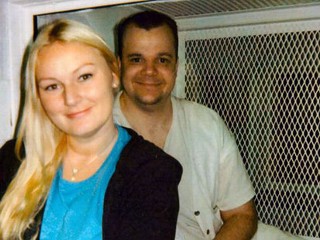
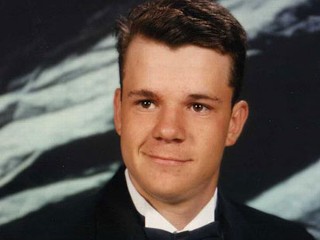
Make a note of this name: Jeffery Lee Wood.
And this date: Thursday, Aug. 21, 2008.
That’s Wood’s scheduled date of execution, two days after his 35th birthday.
Now, go back in time with me.
It was a year ago this month — just outside the prison walls that house the Texas death chamber — when a small group of us staunch death-penalty opponents stood in stunned amazement with the family of a condemned man.
We had just gotten news that Gov. Rick Perry had taken the advice of the Texas Board of Pardons and Paroles and commuted the sentence of Kenneth Foster from death to life in prison. The decree came just a few hours before Foster’s scheduled execution.
Our amazement turned to jubilation on the Huntsville prison grounds that afternoon, not only because Foster’s life had been spared but also because the governor and board had hinted that there were problems with the law under which the inmate had been convicted and sentenced.
Foster had been tried under the "law of parties" designed to treat "conspirators" equally, meaning that all could be considered culpable for the actions of the one who commits a second crime while in the commission of another. Texas is the only state that applies that law in capital cases.
In Foster’s case, he had been riding around with three other men in San Antonio one night when they stopped to talk to a woman. While Foster waited in the car, one of his passengers, Mauriceo Brown, approached the woman’s male companion some distance away.
There was a shot and Brown rushed back to the car and told Foster to drive away. It was then that he learned that Brown had shot the man, later identified as 25-year-old Michael LaHood.
The evidence clearly showed that Foster, while near the scene of the crime, did not and could not have known what his companion would do. Yet, he stood trial with Brown on capital murder charges. Both were convicted and sentenced to death. Brown was executed July 19, 2006.
The governor, in commuting Foster’s sentence, expressed concern that the two defendants had been tried together and suggested that the Legislature should address the law in its next session.
This newspaper editorialized against Foster’s execution and called for the Legislature to re-examine the law of parties.
Wood, convicted under the same law of parties, is set to be executed this week, five months before the next legislative session begins.
His case is more complicated than Foster’s and involves a series of issues that demand his sentence be commuted to life.
Although he was not tried with his co-defendant, a man who’s been executed for the 1996 murder of a Kerrville convenience store operator, prosecutors continued to link him to the killer.
"Daniel Reneau, who coldly murdered Kriss Keeran in the early morning hours of January 2, 1996, has already been executed by the State of Texas for this senseless act," according to a clemency petition submitted to the governor and the Board of Pardons and Paroles. "Nevertheless, on August 21, 2008, the State seeks to execute Jeffery Wood for the same crime, even though the State does not contend that Mr. Wood shot Keeran. In fact, Mr. Wood was not even in the building when Reneau shot and killed Keeran."
Wood was in on a scheme with Reneau to rob the store with the help of the store’s assistant manager, Bill Bunker, according to the petition. It was to have been an inside job, as Bunker had told the two men where the video recording devices were and how much money was expected to be in the safe.
When Reneau went into the store, Wood remained in a pickup and was later shocked by the sound of a gunshot. Reneau had killed Keeran.
The clemency petition suggests that Wood’s culpability for the crime should lie somewhere between Reneau’s and Bunker’s.
Reneau committed the murder and has been executed for it, but "Bunker — despite being a co-conspirator without whose agreement and encouragement the crime never would have occurred — was never charged with any crime," the petition said.
Other issues include whether Wood was even mentally competent to stand trial. One court said he wasn’t, but he was later declared competent. Although the trial court refused to let him represent himself, he, in effect, would not allow his court-appointed attorneys to do their job.
"Bowing to Mr. Wood’s emotional and irrational insistence, Mr. Wood’s appointed lawyers declined to cross-examine any witnesses or present any evidence on Mr. Wood’s behalf," the petition states. "Mr. Wood’s trial attorneys called Mr. Wood’s actions a 'gesture of suicide’ and objected on moral grounds to participating in the arrangement ordered by the trial court — effectively as legal vessels assisting Mr. Wood’s suicidal ends."
Then, in the punishment phase of the trial, the state called Dr. James Grigson (known widely as "Dr. Death") to the stand to testify that if Wood were not given the death penalty he would continue to be a danger to society. Grigson, who had already been discredited, got his nickname because of the hundreds of times he testified for the state in capital cases.
"Despite having a valid license, Grigson was a medical fraud, although Mr. Wood’s jury did not know it," the petition contends. "In 1995, three years before he testified in Mr. Wood’s trial, Grigson was expelled from the American Psychiatric Association and the Texas Society of Psychiatric Physicians for flagrant ethical violations related to his testimony purporting to predict future dangerousness. Because he was not cross-examined, Mr. Wood’s jury was not aware of this information. Nor did the State elicit it, despite its duty to see that justice is done and to disclose impeachment evidence."
At least 10 state legislators have written the Board of Pardons and Paroles, urging clemency for Wood.
I know the governor gets tired of hearing from me on death-penalty cases, but he must commute this sentence.
It is clear that Wood does not deserve to be executed, and no other person should be put to death under a law that many people believe should never have applied to capital cases.
The least we can do is wait until the Legislature deals with this law in its next session.
Bob Ray Sanders’ column appears Sundays and Wednesdays. 817-390-7775


Since Texas reinstated the death penalty in 1976, only six people have been executed for a murder in which they did not directly participate, according to the Death Penalty Information Center. If Texas proceeds with the scheduled Aug. 21 execution of Jeff Wood, that number will climb to seven. Lawyers for the death row inmate, trying to spare their client that fate, are asking the Board of Pardons and Paroles to recommend commuting Wood's sentence to life in prison.
Wood was sentenced to die for the 1996 murder of his friend Kris Keeran, during a botched robbery of a Kerrville Texaco station. Wood did not fire the gun that killed Keeran and wasn't inside the gas station when another friend, Danny Reneau, fired the fatal shot into Keeran's head. (Reneau was executed in 2002.) Nonetheless, according to the state, Wood is responsible for Keeran's death and should be executed. Wood was convicted under the state's law of parties, a conspirator liability statute that posits that if two or more people plan to commit one crime but another crime occurs, each person is equally responsible for that crime, if it was foreseeable. The state argues that Wood hatched with Reneau the plan to rob the Texaco, where their friend Keeran worked, on Jan. 2, when a large amount of cash would still be on hand because of holiday bank closures. That Wood was neither in the store when the killing began nor fired the fatal shot did not mean he was not equally liable for Keeran's murder, the prosecution argued.
But Wood's lawyers, Scott Sullivan and Jared Tyler (with the Texas Defender Service), argue that Wood did not plan to rob the store and, in fact, had no idea Reneau planned to do so – nor, they say, did Wood know Reneau was carrying a gun. Indeed, it isn't clear that Wood had any idea what Reneau would do, although it does appear Wood was privy to a plan hatched by Reneau and Texaco store manager Bill Bunker to lift the post-holiday cash. Wood's sister, Terri Been, says that Keeran initially was in on the plan, but ultimately, she says, Wood and Keeran pulled out, followed by Bunker. As far as Wood knew, she says, the previous talk of a robbery was moot. "Mr. Wood undeniably shares responsibility for what happened to Mr. Keeran, and should be held accountable for his reckless acts, but no man ever deserves to die for another man's acts," Wood's attorneys wrote in his petition to the board, filed last week.
At Reneau's trial, the state argued that he was responsible for Keeran's murder and portrayed Wood as little more than a sap, steamrolled by the villainous Reneau. But at Wood's trial, prosecutors reversed their strategy, arguing that Wood deserved to die because he'd gotten Reneau to "do his dirty work." But the idea of Wood as "mastermind" baffles attorney Sullivan, who has represented Wood since 1998. "I've watched Jeff for ... nine years," he says. "This guy, his mental capacities are not sufficient to make him a mastermind." Wood was diagnosed with learning disabilities as a child, and school officials consistently categorized him as emotionally stunted. He always sought approval for his actions and, adds his family, was easily influenced by others. He was initially found incompetent to stand trial because he was incapable of helping his defenders. At the punishment phase of his trial, Wood tried to fire his attorneys, a request denied by the judge. Nonetheless, his trial attorneys followed Wood's orders: Not only did they withhold from the jury evidence of his troubled youth, but they also failed to cross-examine any state witnesses, including the wildly speculative testimony of Dr. James Grigson – derisively known by many, including colleagues in the psychiatric community, as "Dr. Death" for predictably offering testimony in capital cases that a defendant would pose a danger to society, one of the questions a jury must decide in order to impose a death sentence.
In Wood's case, Grigson testified the defendant would pose a continuing threat to society if sentenced to anything other than death. That was clear to him, he said, because Wood was a manipulative person who failed to wear a disguise during the Texaco robbery. "You have an individual that is a user or manipulator of other people, and I'm thinking particularly in terms of where you're planning the robbery for two weeks," he testified, responding to a "hypothetical" robbery-murder presented by prosecutors that mirrored closely most of the facts of the Keeran killing. "Surely, you would have thought in terms of using a mask or a disguise where you wouldn't have to kill somebody, so this was a deliberate and intentional act in terms of the clerk that was going to be killed." (Wood's attorneys assert in the clemency petition that Grigson should not have been allowed to testify, in part because of his 1995 ouster from the American Psychiatric Association and Texas Society of Psychiatric Physicians for "flagrant ethical violations" – a fact the jury did not know because neither of Wood's attorneys conducted any cross-examination.)
Sullivan and Tyler argue now that executing Wood for a murder he did not commit would undermine Texas' entire death penalty scheme. The U.S. Supreme Court, they note, has said, "When the law punishes by death, it risks its own sudden descent into brutality, transgressing the constitutional commitment to decency and restraint." If Wood is executed, they write, "that risk will have come to fruition, and we all will have taken a descent into brutality unworthy of the State of Texas."
The Board of Pardons and Paroles can vote either to recommend or deny clemency for Wood. If they vote to commute Wood's sentence to life in prison, Gov. Rick Perry has the power to accept or deny the recommendation.