Support Keller impeachment
Sharon Keller denied Michael Richard’s constitutional rights when she closed her courtroom at 5 p.m. and refused to accept his last-minute appeal (“Representative initiates efforts for impeachment of Sharon Keller,” April 28). Justice is not a 9 a.m. to 5 p.m. issue, and everyone deserves a fair hearing in the court of law, even those who we deem to be the worst of our society. HR 480 is the only way to get Keller off the bench promptly, rather than the long process through the Commission on Judicial Ethics.
I invite everyone to visit www.sharonkiller.com and contact members of the House Committee on Judicial and Civil Jurisprudence in support of Rep. Lon Burnam’s impeachment resolution. By removing Sharon “Killer” Keller from the bench, we can set the example for others that no one is above the law, even the presiding judge of Texas’ highest criminal court.
Hooman Hedayati
Government and Middle Eastern studies senior
Campaign to End the Death Penalty
Showing posts with label Daily Texan. Show all posts
Showing posts with label Daily Texan. Show all posts
Wednesday, April 29, 2009


Thursday, February 21, 2008
Daily Texan endorses Rick Reed
On Wednesday the Daily Texan endorsed Rick Reed for the Travis County District Attorney. Here is what they had to say about him.
Since Ronnie Earle has decided not to seek re-election after holding the seat for 31 years, a new district attorney is something many Travis County voters will see for the first time this year. Four qualified Democratic candidates, all assistant district attorneys, are vying for the seat, and because no Republican bothered to file, the primary election is the real deal - that is, unless there's a runoff.
Rick Reed, a UT alum, has made himself a standout in this race by being the only candidate to publicly oppose the death penalty (something a district attorney in Texas has never done before). Travis County residents would see at least a temporary abolishment of the death penalty if they elect him to office. While his opponent Rosemary Lehnmerg - who seems to have garnered the most endorsements, including that of Earle - has said "we should not perform any executions," she hasn't taken the initiative to officially oppose the death penalty, which we see as a weakness in authority.
Reed has also brought attention to himself by revealing to the Texas Observer last month that there was "bitter dissention" in the district attorney's office leading up to former House Majority Leader Tom DeLay's indictment for campaign finance violations, claiming that Lehmberg and other prosecuters were intimidated by DeLay's political stature. Reed, who is credited with building a large part of the case against DeLay, said he was the only person pushing to present the case to a grand jury.
Meanwhile, UT alum Mindy Montford, who has earned the endorsement of the University Democrats, seems to think becoming friends with the political sector is a good way of fighting corruption of state officials; she told the Observer, "We've got to educate the Legislature and the lobby that, 'Look, you've got nothing to be afraid of if you're following the law.'" And no wonder she's been the most popular in gaining cash and endorsements from politicians, such as former Texas Governors Dolph Briscoe and Mark W. White. The financial assistance she's gotten from her father, John Montford, who is a head lobbyist for AT&T Inc. and a former state senator, has put her in the lead of the money race.
On the topic of the death penalty, Montford said at a recent candidate forum that the district attorney must set aside personal feelings because "you can't necessarily dictate how you feel the law should be; it's what's on the books." We'd rather have a district attorney whose heart and mind are behind his or her actions, no matter how intimidating or difficult the circumstances may be.
Given the difficulty in choosing from four candidates of such high qualifications, we must rule out an endorsement of 46-year-old Gary Cobb, who has worked under Earle for 17 years, solely on the fact that he's the only one who hasn't worked in the state-watchdog Public Integrity Unit. We'd also be quite happy to see Lehmberg win the seat. But the district attorney is the sole prosecutor with the power to investigate state officials, and Reed has proven to be the toughest candidate to handle just that. We're a bit set back his finger-pointing in his interview with the Observer, but that only shows his aptitude and fearlessness in pointing the finger at public officials if need be.
Friday, December 07, 2007
Today's legal lynchings
By Hooman Hedayati
The next time you travel to downtown Houston to visit the Museum of Fine Arts, you should walk a few blocks to Houston's Old Hanging Tree at the corner of Capital and Bagby streets. That huge 200-year-old oak tree is the location where many "Negroes" were illegally lynched many years ago. Almost 150 years after the Civil War ended, Texas remains haunted by its long history of slavery, and even today the state still practices lynching. But today it is done by the state, rather than a group of white-hooded men. It is called execution by lethal injection.
In the 1920s, as people started to become more repelled by the brutality of illegal lynchings, some people started to look into alternatives to lynching, thanks to the efforts of the Niagara Movement and the NAACP. The answer came from J. W. Thomas in a small town near Waco, who ran for the state Senate on a platform that "hangings should be removed from the emotional atmosphere of local communities to the more remote prison in Huntsville." In the early hours of Feb. 8, 1924, five condemned black murderers from rural East Texas were electrocuted. Thus began the modern era of executions in Texas. Today, the small town of Huntsville in Walker County is the headquarters of the Texas Department of Criminal Justice and the Walls Unit Prison, which holds Texas' infamous death chamber. In 2007, the state of Texas executed 25 men, most of them black or Hispanic.
The last person to be execution by Texas was Michael Richard, another black man who died on Sept. 25 only because Texas Court of Criminal Appeals Presiding Judge Sharon Keller did not want to stay at work a few minutes past five o'clock to consider his appeal. Who cares about a black man getting executed anyway? Maybe she wanted to make it over to Whole Foods before the masses.
People of color have accounted for a disproportionate 43 percent of total executions in the U.S. since 1976 and comprise 55 percent of those currently awaiting execution. According to Amnesty International, at least one in five of the African-Americans executed since 1977 were convicted by all-white juries, in cases which displayed a pattern of prosecutors dismissing prospective black jurors during jury selection. A training handbook once used by the Dallas County District Attorney's office actually said, "Do not take Jews, Negroes, Dagos, Mexicans or a member of any minority race on a jury, no matter how rich or how well-educated." Even though blacks and whites are murder victims in nearly equal numbers of crimes, 80 percent of people executed since the death penalty was reinstated have been executed for murders involving white victims.
The overwhelming evidence suggesting a racial bias in our criminal justice system and possible execution of African Americans and other minorities, who might have been found innocent otherwise, should shake the soul of every human being. We need to accept the relationship between our current criminal justice system and the 1920s lynch mobs. Now is the time to recognize, as most of the countries around the world have recognized, that the death penalty cannot be implemented fairly. It is the time to follow in the steps of abolitionists such as Frederick Douglas and abolish the blatant, unjust application of legalized lynching in our criminal justice system.
Hedayati is a government junior.
The next time you travel to downtown Houston to visit the Museum of Fine Arts, you should walk a few blocks to Houston's Old Hanging Tree at the corner of Capital and Bagby streets. That huge 200-year-old oak tree is the location where many "Negroes" were illegally lynched many years ago. Almost 150 years after the Civil War ended, Texas remains haunted by its long history of slavery, and even today the state still practices lynching. But today it is done by the state, rather than a group of white-hooded men. It is called execution by lethal injection.
In the 1920s, as people started to become more repelled by the brutality of illegal lynchings, some people started to look into alternatives to lynching, thanks to the efforts of the Niagara Movement and the NAACP. The answer came from J. W. Thomas in a small town near Waco, who ran for the state Senate on a platform that "hangings should be removed from the emotional atmosphere of local communities to the more remote prison in Huntsville." In the early hours of Feb. 8, 1924, five condemned black murderers from rural East Texas were electrocuted. Thus began the modern era of executions in Texas. Today, the small town of Huntsville in Walker County is the headquarters of the Texas Department of Criminal Justice and the Walls Unit Prison, which holds Texas' infamous death chamber. In 2007, the state of Texas executed 25 men, most of them black or Hispanic.
The last person to be execution by Texas was Michael Richard, another black man who died on Sept. 25 only because Texas Court of Criminal Appeals Presiding Judge Sharon Keller did not want to stay at work a few minutes past five o'clock to consider his appeal. Who cares about a black man getting executed anyway? Maybe she wanted to make it over to Whole Foods before the masses.
People of color have accounted for a disproportionate 43 percent of total executions in the U.S. since 1976 and comprise 55 percent of those currently awaiting execution. According to Amnesty International, at least one in five of the African-Americans executed since 1977 were convicted by all-white juries, in cases which displayed a pattern of prosecutors dismissing prospective black jurors during jury selection. A training handbook once used by the Dallas County District Attorney's office actually said, "Do not take Jews, Negroes, Dagos, Mexicans or a member of any minority race on a jury, no matter how rich or how well-educated." Even though blacks and whites are murder victims in nearly equal numbers of crimes, 80 percent of people executed since the death penalty was reinstated have been executed for murders involving white victims.
The overwhelming evidence suggesting a racial bias in our criminal justice system and possible execution of African Americans and other minorities, who might have been found innocent otherwise, should shake the soul of every human being. We need to accept the relationship between our current criminal justice system and the 1920s lynch mobs. Now is the time to recognize, as most of the countries around the world have recognized, that the death penalty cannot be implemented fairly. It is the time to follow in the steps of abolitionists such as Frederick Douglas and abolish the blatant, unjust application of legalized lynching in our criminal justice system.
Hedayati is a government junior.
Wednesday, October 31, 2007
Daily Texan coverage of Sharon Keller protest
The Daily Texan has a good article about last night's press conference at Sharon Keller's home. Even though the lights inside her home were on, she didn't come out. Surprisingly this time she didn't call DPS, as she did last year over the website sharonkiller.com.
Protest hits home for Texas judge who refused to hear late appealBy Amanda DeBardMedia Credit: Bryant HaertleinAustin anti-death penalty activist Alison Dieter protests outside of the home of Judge Sharon Keller on Tuesday evening.
A group of activists opposing the death penalty rallied outside Judge Sharon Keller's home in North Austin Tuesday night.
Keller presides over the Texas Court of Criminal Appeals and refused to accept a late death penalty appeal on Sept. 25, which resulted in Michael Richard's execution.
"We came to where we think she can hear us," said Scott Cobb, president of the Texas Moratorium Network, an organization in opposition of the death penalty.
Keller told attorneys filing Richard's appeal that the office closes at 5 p.m. and would not grant them the 20 extra minutes they requested due to computer printer malfunctions. There was another attorney assigned to handle late appeals that night, who Keller did not consult with prior to her decision.
Cobb said the protest occurred at Keller's house because most members of his organization work until 5 p.m. when the Court of Criminal Appeals office would be closed.
Keller did not come out of her house at any point during the protest and did not respond to knocks on her front door.
In light of Richard's execution, Cobb said he thinks the trust in and integrity of the criminal justice system has been lost.
"We're asking for her to be removed from office to restore the integrity of the system," he said. "If there is no trust in the system, then the whole thing breaks down."
About 1,200 public members have signed the judicial complaint against Keller, which will be delivered to the State Commission on Judicial Conduct Nov. 6. The complaint is sponsored by the Texas Moratorium Network.
Members of the Austin chapter of the Campaign to End the Death Penalty criticized Keller's actions in the courtroom in addition to her actions on the night in question.
In the past, Keller has allowed attorneys to sleep through capital murder trials, said Kathleen Feyh, a UT graduate student and member of the organization, referencing a capital murder trial for Calvin Burdine, whose lawyer, Joe Cannon, slept through parts of his client's trial.
"We haven't seen her treat cases with any passion, and she does not view defendants as human," she said.
Feyh said she believes the Richard case was the straw that broke the camel's back but said she wishes Keller's actions had come much sooner. After Richard's execution, no other Texas inmates have been executed.
"Any halt to executions is a good step and a step in the right direction," Feyh said.

Thursday, October 18, 2007
Killer Keller must resign
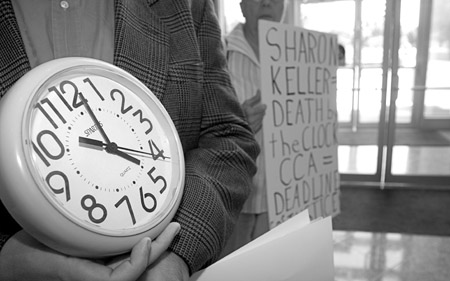
Photo by Jana Birchum
Published by The Daily Texan
"We close at five." It took these four words for Texas Court of Criminal Appeals Presiding Judge Sharon Keller to deny a convicted killer's last appeal. On September 25, the same day the U.S. Supreme Court granted a writ of certiorari to a Kansas inmate questioning the constitutionality of lethal injection, Michael Richard was scheduled to be executed. The attorneys for the Texas Defenders Service requested that the court clerk's office remain open 20 minutes after the 5 p.m. closing time because their computers had crashed. Keller shocked the world by closing the court's office at 5 p.m. on an execution day without even consulting any of the other judges of the court. As a result, a man was executed without being able to have the merits of his last appeal considered by the criminal justice system.
The Court of Criminal Appeals is the highest criminal court in Texas and must rule on every case before the U.S. Supreme Court can consider an appeal for a stay of execution. If the CCA had accepted the case and voted to deny Richard a stay, the U.S. Supreme Court could have issued a stay. That is exactly what happened in another case two days after Richard's execution, when the court voted 5-4 to deny a stay to Carlton Turner, but U.S. Supreme Court issued a stay of execution.
According to the Houston Chronicle, several judges were in the court while Keller turned down the appeal. Judge Paul Womack stayed as late as 7 p.m. expecting to receive a late filing. Judge Cheryl Johnson, who was the assigned judge to handle any late appeals, was not even informed, in Richard's case, of Keller's action until she read the story in the Austin American-Statesman.
"And I was angry," she told the Statesman. "If I'm in charge of the execution, I ought to have known about those things, and I ought to have been asked whether I was willing to stay late and accept those filings."
Keller's action denied Michael Richard two constitutional rights, access to the courts and due process, which led to his execution. Her actions also brought the integrity of the Texas judiciary system and of her court into question. But this is not the first time Keller has behaved like a buffoon. In 2000, she wrote the majority opinion in the case of Roy Criner, claiming that the new DNA evidence proving his innocence in a rape and murder case did not warrant a new trial because he could have "failed to ejaculate." According to Tom Price, one of the other conservative judges on the Texas Court of Criminal Appeals, as far back as 2001 she made Texas' highest criminal appeals court "a national laughingstock."
To close at 5 p.m. and refuse to accept an appeal by a person about to be executed is a violation of judicial responsibility. When a person is about to be executed, our state's highest criminal court needs to remain open for business. As long as Keller is in office, the people of Texas cannot be sure that justice is being done with integrity. Judge Sharon Keller should resign or be removed from office by the State Commission on Judicial Conduct, which is responsible for investigating allegations of judicial misconduct.
If you are as shocked as I was by Judge Sharon Keller's refusal to accept an appeal 20 minutes after 5 p.m. from lawyers representing a man about to be executed, then sign on to the general public complaint against Judge Sharon Keller by going to SharonKiller.com. The complaint will be submitted to the State Commission on Judicial Conduct on Oct. 30.
Hedayati is a government junior, Students Against the Death Penalty president and a Campus Progress at the Center for American Progress advisory board member.
Tuesday, October 09, 2007
National neglect and our death penalty struggle
Also in The Daily Texan
In August the nation saw the result of months of the Texas anti-death penalty movement's tireless work: the commutation of Kenneth Foster's death sentence, mere hours before his scheduled execution. In September the U.S. Supreme Court announced that it would take a Kentucky case to decide if the method of lethal injection used by many states, including Texas, constitutes cruel and unusual punishment. As a result, there could be a de facto moratorium on executions nation-wide, and possibly in Texas, until there is a ruling on this case. However, despite the recent successes at the Supreme Court and of the Kenneth Foster campaign, the Texas anti-death penalty movement is in troubling shape. Major foundations and national anti-death penalty leaders see Texas as a lost cause and are choosing not to fund a grassroots infrastructure here.
An enormous opportunity looms in Texas to actually achieve a moratorium on executions because of growing awareness that innocent people can be caught up in the system. But, lacking support on the national scale, Texas groups working to stop executions are not as well-equipped as they could be to take advantage of this ripe political moment.
The Kenneth Foster campaign taught us that organizing at the grassroots level works. Gov. Rick Perry would not have stopped Kenneth Foster's execution if there had been no public outrage concerning the planned death of a person who had not killed anyone. The group that played the biggest role in stopping Foster's execution was a student organization right here at UT: the Campaign to End the Death Penalty. In a thank-you letter after his commutation, Kenneth Foster wrote, "these people are gladiators when it comes to grassroots activism, and they definitely were the force behind this frontline."
The Texas nonprofit groups dedicated to abolishing the death penalty are run mainly by volunteers, and they lack funding and professional staff. There is not a single person in any grassroots anti-death penalty organization in Texas who is paid to work full-time. However, other states with far fewer executions than Texas have several full time staff members and much more funding.
Hundreds of thousands of dollars have been directed to fight the death penalty in states such as New York and New Jersey, where there have not even been any executions since the 1960s. If that kind of money could come to Texas, it would be much easier to put pressure on policymakers. A bill to create an Innocence Commission in Texas died last May in the House Criminal Jurisprudence Committee, and its failure to pass was a direct result of misplaced priorities by the national anti-death penalty movement.
The Tides Foundation's Death Penalty Mobilization Fund donated $50,000 last year to the Wisconsin Coalition Against the Death Penalty and $20,000 to Iowans Against the Death Penalty. What's wrong with this picture? Neither Wisconsin nor Iowa even has a death penalty. Wisconsin has not executed anyone since the mid-19th century. Meanwhile, five Texas executions were scheduled in September alone, and more than 400 people have been executed in Texas since 1982. Still, a group of several Texas anti-death penalty organizations applied to the same Tides funding program but received nothing.
The JEHT Foundation (Justice, Equality, Human dignity and Tolerance) gave a total of $542,400 to New Yorkers Against the Death Penalty from 2004 to 2006, but there hasn't been an execution in New York since 1963, and there is one person on that state's death row.
Working against the death penalty in Texas is not a lost cause, as working against segregation in Montgomery, Ala., was also not a lost cause during the civil rights movement in the 1960s. While Texas is ground zero in the fight to abolish the death penalty, we are making progress. But to continue this progress, the national anti-death penalty movement should invest more time and money in our state. How many lives could have been saved, as was Kenneth Foster's, if national campaigns channeled more funds into Texas over the last 10 years?
In August the nation saw the result of months of the Texas anti-death penalty movement's tireless work: the commutation of Kenneth Foster's death sentence, mere hours before his scheduled execution. In September the U.S. Supreme Court announced that it would take a Kentucky case to decide if the method of lethal injection used by many states, including Texas, constitutes cruel and unusual punishment. As a result, there could be a de facto moratorium on executions nation-wide, and possibly in Texas, until there is a ruling on this case. However, despite the recent successes at the Supreme Court and of the Kenneth Foster campaign, the Texas anti-death penalty movement is in troubling shape. Major foundations and national anti-death penalty leaders see Texas as a lost cause and are choosing not to fund a grassroots infrastructure here.
An enormous opportunity looms in Texas to actually achieve a moratorium on executions because of growing awareness that innocent people can be caught up in the system. But, lacking support on the national scale, Texas groups working to stop executions are not as well-equipped as they could be to take advantage of this ripe political moment.
The Kenneth Foster campaign taught us that organizing at the grassroots level works. Gov. Rick Perry would not have stopped Kenneth Foster's execution if there had been no public outrage concerning the planned death of a person who had not killed anyone. The group that played the biggest role in stopping Foster's execution was a student organization right here at UT: the Campaign to End the Death Penalty. In a thank-you letter after his commutation, Kenneth Foster wrote, "these people are gladiators when it comes to grassroots activism, and they definitely were the force behind this frontline."
The Texas nonprofit groups dedicated to abolishing the death penalty are run mainly by volunteers, and they lack funding and professional staff. There is not a single person in any grassroots anti-death penalty organization in Texas who is paid to work full-time. However, other states with far fewer executions than Texas have several full time staff members and much more funding.
Hundreds of thousands of dollars have been directed to fight the death penalty in states such as New York and New Jersey, where there have not even been any executions since the 1960s. If that kind of money could come to Texas, it would be much easier to put pressure on policymakers. A bill to create an Innocence Commission in Texas died last May in the House Criminal Jurisprudence Committee, and its failure to pass was a direct result of misplaced priorities by the national anti-death penalty movement.
The Tides Foundation's Death Penalty Mobilization Fund donated $50,000 last year to the Wisconsin Coalition Against the Death Penalty and $20,000 to Iowans Against the Death Penalty. What's wrong with this picture? Neither Wisconsin nor Iowa even has a death penalty. Wisconsin has not executed anyone since the mid-19th century. Meanwhile, five Texas executions were scheduled in September alone, and more than 400 people have been executed in Texas since 1982. Still, a group of several Texas anti-death penalty organizations applied to the same Tides funding program but received nothing.
The JEHT Foundation (Justice, Equality, Human dignity and Tolerance) gave a total of $542,400 to New Yorkers Against the Death Penalty from 2004 to 2006, but there hasn't been an execution in New York since 1963, and there is one person on that state's death row.
Working against the death penalty in Texas is not a lost cause, as working against segregation in Montgomery, Ala., was also not a lost cause during the civil rights movement in the 1960s. While Texas is ground zero in the fight to abolish the death penalty, we are making progress. But to continue this progress, the national anti-death penalty movement should invest more time and money in our state. How many lives could have been saved, as was Kenneth Foster's, if national campaigns channeled more funds into Texas over the last 10 years?
Wednesday, July 25, 2007
Hundreds march for Kenneth Foster
 Hundreds of Texans marched down the Congress Avenue and later at the Governor's Manssion last Saturday calling on Gov. Rick Perry to stop execution of Kenneth Foster. As Scott Cobb of TMN mentioned, "The rally for Kenneth Foster last Saturday was probably the best, most well-attended, high energy protest of a pending execution in Texas since the Gary Graham protests back in 2000." The event received coverage on Democracy Now, KXAN, News 8 Austin and The Daily Texan. I will have some video clips from the rally by tomorrow.
Also last Sunday San Antonio Express-News published an OpEd by Prof.
Subscribe to:
Posts (Atom)