Showing posts with label Hooman Hedayati. Show all posts

Monday, May 30, 2011

Execution Watch: Gayland Bradford

Gayland Bradford


By Elizabeth Ann Stein
Producer, Execution Watch


(HUNTSVILLE, Tex.) -- Texas is preparing to put to death Gayland Bradford Wednesday in what is slated to be the first of four executions in Texas during June. Execution Watch will provide live radio coverage and analysis.

Unless  Bradford receives a last-minute stay, the program will air during the execution June 1, from 6:00 p.m. to 7:00 p.m. Central Time. It may be heard in the Houston area on KPFT 90.1 FM and over the internet at executionwatch.org > Listen.

'TEXAS PLANS TO EXECUTE:
GAYLAND BRADFORD, 42, came within six days of being executed in October, when the U.S. Supreme Court issued a stay to give his attorneys time to prepare a full appeal of his sentence on grounds that he is mentally impaired. Bradford was sentenced to death in the slaying of a Dallas security guard. His attorneys say his execution would be unconstitutional because he is mentally retarded. Texas prison officials tested his IQ at 68 when he was a 17-year-old first offender. More background at http://executionwatch.org > Backpage on Gayland Bradford.

SHOW LINEUP
Host: RAY HILL, an ex-convict whose activism has included shepherding several cases to the U.S. Supreme Court., he founded, and hosted for 30 years, the Prison Show on KPFT. His new internet talk show may be heard every weekday on hmsnetradio.org at 2 p.m. CT.

Legal Analyst: JIM SKELTON, a legal educator and retired attorney, he’s a native Texan and  iconoclast who has seen capital trials from both the prosecution table and the defense table.

Featured Interview: HOOMAN HEDAYATI. He is Texas Field Organizer for Witness to Innocence, which seeks to empower death row survivors and their loved ones to be effective leaders in the movement to abolish the death penalty. As a student at UT-Austin, he founded the national organization, Students Against the Death Penalty. A board member of the Texas Moratorium Network, he testified before legislators recently on death-penalty-related legislation. The website for Witness to Innocence: www.witnesstoinnocence.org/.

Reporter, Death House, Huntsville: GLORIA RUBAC. Founder of the Texas Death Penalty Abolition Movement, abolitionmovement.org/

Reporter, Texas Vigil: DAVE ATWOOD. Founder and board member, Texas Coalition to Abolish the Death penalty; author of memoir, Detour to Death Row. www.tcadp.org.

NEXT SCHEDULED EXECUTION
On June 15, Texas plans to execute JOHN BALENTINE. If that happens, Execution Watch will broadcast. Details: executionwatch.org

PRODUCER: Elizabeth Ann Stein, eliza.tx.usa @gmail.com.
TECHNICAL DIRECTOR: Otis Maclay, omaclay @gmail.com.
THEME:  By Victoria Panetti, SheMonster International, myspace.com/shemonster.

Tuesday, October 20, 2009

The Daily Texan: March Against the Death Penalty

The following is Hooman Hedayati's column in today's The Daily Texan about the 10th Annual March to Abolish the Death Penalty.

Would you oppose the death penalty if it were proven that Texas has executed an innocent man? If so, remember this name: Cameron Todd Willingham. He was innocent and Texas executed him. There are plenty of executed death-row inmates with strong claims of innocence, such as David Spence, Ruben Cantu, Carlos De Luna and Gary Graham. But the state of Texas has never admitted to killing an innocent person. Willingham’s case could become the first case in which the state of Texas will have to admit that it made
a mistake.

Willingham was executed for arson and murder in 2004. He professed his innocence until he was strapped down on the execution gurney, saying “I am an innocent man — convicted of a crime I did not commit. I have been persecuted for 12 years for something I did not do.”

Now, we know that he was telling the truth. In August, Craig Beyler, the investigator hired by the Texas Forensic Science Commission to review the Willingham case, released his report in which he found that “a finding of arson could not be sustained” by a scientific analysis. He concluded that the fire in the Willingham case was accidental and not arson. In fact, there was no arson, so there was no crime.

David Grann wrote a 16,000-word article for The New Yorker in which he discredited all the evidence used to convict and sentence Willingham. Barry Scheck, co-director of the Innocence Project said, “After reading Grann’s report, fair-minded people will know beyond a reasonable doubt that an innocent person was executed.”

The proven execution of an innocent person should have resulted in a call by Gov. Rick Perry for a statewide moratorium on executions and a commission to conduct a comprehensive study of the Texas death penalty system. But shortly before a scheduled Texas Forensic Science Commission meeting to discuss this case, in a move that looks like an election-year cover-up, Perry replaced several members of the commission with his own political allies, including John Bradley, a tough-on-crime Williamson County defense attorney, as chairman. Bradley canceled the public hearing indefinitely, leaving the investigation in limbo.

Scott Cobb, director of the Texas Moratorium Network, said, “No matter how things turn out, people are looking at the death penalty in a new light. They’re thinking if it could have happened to Willingham, then it could happen to many other people.”

U.S. Supreme Court Justice Antonin Scalia wrote in 2006 that in the modern judicial system there has not been “a single case — not one — in which it is clear that a person was executed for a crime he did not commit. If such an event had occurred in recent years, we would not have to hunt for it; the innocent’s name would be shouted from the rooftops.”

This Saturday, at the 10th Annual March to Abolish the Death Penalty, people from all walks of life and all parts of Texas, the U.S. and other countries will gather at the Texas Capitol to raise their voices and shout out Todd Willingham’s name. The march is a gathering of activists, exonerated inmates and family members of the victims and those on death row.

Eugenia Willingham, mother of Todd Willingham, will be among the special guests at the march on Saturday at 2 p.m. on the South Steps of the Capitol.

On Friday, students can also join a panel discussion with exonerated death-row inmates Shujaa Graham and Curtis McCarty (7 p.m. in the Texas Union’s Sinclair Suite, Room 3.128).

I encourage everyone to attend the march to support the Willingham family as they fight to prove that Todd Willingham was innocent.

For more information and to sign a petition, visit camerontoddwillingham.com and marchforabolition.org.

Hedayati is a government and Middle Eastern studies senior and member of the Campaign to End the Death Penalty.

Wednesday, August 27, 2008

No moratorium on the death penalty's flaws

The column below appeared in the August 27, 2008 edition of UT-Austin's Daily Texan newspaper.

In 2007, the Supreme Court accepted a case from a Kentucky inmate challenging the constitutionality of lethal injections. This created a national moratorium on executions that lasted for more than seven months. Now, after the longest death penalty moratorium in 25 years, executions have resumed in the U.S. Georgia executed the first inmate, and Texas followed, executing eight more people. The next execution in Texas is scheduled for Sept. 9. Litigation that caused the moratorium did not question the death penalty itself but rather the manner in which it is carried out. This forest-for-the-trees approach, however, avoids a fundamental question: What did we learn during the seven-month-plus postponement? And how should what we learned influence us as we go forward?

Arizona Judge Rudolph Gerber, who came to oppose the death penalty after serving on the state's appeals court, recently noted that the moratorium has had several ripple effects. "Around the country, no judges are staying up late awaiting the final appeals from the condemned," he wrote in an op-ed for The Sacramento Bee. "Governors and justices of the Supreme Court are not worrying that the person about to be executed may be the exceptional one who is innocent. Prison guards, family members of victims and of death row inmates, and even the media are relieved of the tension and uncertainty that each pending execution brings."

"But much of the death penalty system remains unaffected by this hold on executions," Gerber continued. "Prosecutions, trials, appeals and the rituals of death row continue to absorb an enormous share of the judicial system's time and resources. Justices from some of the states' highest courts have complained about the extraordinary strain this one issue places on the bench. In many states, there are not enough qualified lawyers willing to handle the appeals."

Gerber brought a real-world analysis to the issue of capital punishment. But he could have gone even further. The fact is, our 30-year experiment with capital punishment has failed. The death penalty system remains flawed and fraught with blunders, biases and bureaucracies. Blunders, because too often it convicts innocent people and sends them away to await execution. Biases, because no matter how much we tinker, we can't get around the fact that race and class influence who receives the ultimate penalty. Bureaucracies, because appeals can take decades - and it is the murder victim's family members who suffer as the appeals of the perpetrator who took their loved one away wend interminably through the courts.

During the recent moratorium on executions, several notable things happened. Three states - California, North Carolina and Tennessee - launched studies of their death penalty systems. Two states, Maryland and Nebraska, debated abolishing the death penalty in their state legislatures. A third state, New Jersey, did away with capital punishment altogether. For the first time in Texas, Rick Reed, a candidate for the Travis County district attorney's office, ran on a platform opposing capital punishment.

What happened when states paused and contemplated the pros and cons of this public policy? If anything, more Americans came to question whether the death penalty is really necessary. And more Texans learned that without the death penalty, the word doesn't turn upside down, murder rates don't skyrocket and death-row inmates don't run away from prisons murdering more people. During this period, more people questioned what we are accomplishing and if the significant costs of conducting trials and appeals could be put to better use.

One American who thought so was Supreme Court Justice John Paul Stevens. "The time for a dispassionate, impartial comparison of the enormous costs that death penalty litigation imposes on society with the benefits that it produces has surely arrived," Stevens wrote in the latest court case. Stevens - voting to uphold the constitutionality of a specific lethal injection protocol but expressing his view that the death penalty itself now violates the Eighth Amendment - saw the forest for the trees. As Texas rushes to execute more inmates, we all could use Stevens' clarity and vision.

Hedayati, a government senior, is president of Students Against the Death Penalty, member of Campaign to End the Death Penalty and Campus Progress at the Center for American Progress advisory board member.

Monday, February 25, 2008

Rick Reed best choice for district attorney

Published by The Daily Texan
By Hooman Hedayati

On March 4, Travis County residents will vote for a new district attorney. Ronnie Earle, the current district attorney, announced last year that he is planning to retire after more than 30 years in office. Four of Earle's assistant district attorneys, Rosemary Lehmberg, Rick Reed, Gary Cobb and Mindy Montford, are running to replace him. This race is probably the most important local race and is being watched nationally. The Travis County DA is a unique position because it has the special privilege of investigating and prosecuting public officials through the Public Integrity Unit, and for the first time, there is a chance that Travis County might take the death penalty off the table. Last year, when Texas Monthly's Paul Burka announced Earl's plan to retire, he said that "a DA is supposed to be the conscience of the community." This brings up the issue of how the next district attorney should handle death penalty cases in a county where a big majority believes that the death penalty system in Texas is broken. Each candidate is running in the upcoming Democratic primary without a Republican challenger, so whichever one wins the Democratic primary will be the next DA.

All four candidates have years of experience working as prosecutors. Lehmberg, Ronnie Earle's choice to replace him, has headed many divisions in the DA's office, from chief of the Trial Division to director of the Public Integrity Unit. Montford is the only candidate who has legislative experience. She worked as general counsel to Texas Sen. Eddie Lucio and helped write the life-without-parole legislation. Cobb is the only black prosecutor in the race and has the endorsement of the Austin Police Officers Association. Reed has prosecuted the most cases out of any of the candidates, and has taken the most progressive stances on the issues.

But three of the candidates remain pro-death penalty. Lehmberg is the status-quo candidate who promises to continue with the current system, and Montford has also said that she would continue to use the death penalty. Cobb has made the strongest pro-death penalty statements, having said that "some people didn't deserve to keep living."

Cobb also came under fire when he used a coerced confession to convict Lacresha Murray, an 11-year-old girl charged with capital murder in 1996. Cobb was the lead prosecutor in her case, which was later thrown out by a Republican appeals court after receiving national coverage on "60 Minutes" questioning the reasoning for charging someone so young with a capital crime.

The only candidate who has come out against the death penalty is Reed, and his adamant anti-death penalty platform would bring fundamental change from the status quo, pro-death penalty campaigns of the other three candidates. Reed is by far the most progressive candidate in this race.

Reed's view on the death penalty is not the only thing that sets him apart. He supports expanding the use of drug courts to divert more people charged with drug possession into treatment, freeing up more prosecutors for other crimes. He has promised to work closely with the Innocence Project to investigate cases of possible wrongful convictions, as has been done recently by the Dallas County DA. Reed wants to decentralize decision-making in the office, giving front-line prosecutors more discretion over their cases. Most importantly, he spearheaded the money-laundering case against former U.S. House Majority Leader Tom DeLay, and he told the Texas Observer that he was the only person within the DA's office pushing for an indictment against Delay, while Lehmberg opposed prosecuting the powerful politician.

A large number of voters believe that the death penalty system in Texas is broken and should not be used until steps are taken to address the problems, and many oppose the death penalty altogether based on principle. Either way, there is likely to be a large amount of support in Austin for candidates who take stands against the death penalty, especially in a race in which the winner has the power to unilaterally end the use of the death penalty within Travis County. It is not too late for the other candidates to take a position on the death penalty that reflects the values and priorities of the progressive community from which they seek votes. All the candidates for Travis County DA should follow Reed's example and say that they will not support the death penalty.

Hedayati is a government junior, Students Against the Death Penalty President and a Campus Progress at the Center for American Progress advisory board member.

Friday, December 07, 2007

Today's legal lynchings

By Hooman Hedayati

The next time you travel to downtown Houston to visit the Museum of Fine Arts, you should walk a few blocks to Houston's Old Hanging Tree at the corner of Capital and Bagby streets. That huge 200-year-old oak tree is the location where many "Negroes" were illegally lynched many years ago. Almost 150 years after the Civil War ended, Texas remains haunted by its long history of slavery, and even today the state still practices lynching. But today it is done by the state, rather than a group of white-hooded men. It is called execution by lethal injection.

In the 1920s, as people started to become more repelled by the brutality of illegal lynchings, some people started to look into alternatives to lynching, thanks to the efforts of the Niagara Movement and the NAACP. The answer came from J. W. Thomas in a small town near Waco, who ran for the state Senate on a platform that "hangings should be removed from the emotional atmosphere of local communities to the more remote prison in Huntsville." In the early hours of Feb. 8, 1924, five condemned black murderers from rural East Texas were electrocuted. Thus began the modern era of executions in Texas. Today, the small town of Huntsville in Walker County is the headquarters of the Texas Department of Criminal Justice and the Walls Unit Prison, which holds Texas' infamous death chamber. In 2007, the state of Texas executed 25 men, most of them black or Hispanic.

The last person to be execution by Texas was Michael Richard, another black man who died on Sept. 25 only because Texas Court of Criminal Appeals Presiding Judge Sharon Keller did not want to stay at work a few minutes past five o'clock to consider his appeal. Who cares about a black man getting executed anyway? Maybe she wanted to make it over to Whole Foods before the masses.

People of color have accounted for a disproportionate 43 percent of total executions in the U.S. since 1976 and comprise 55 percent of those currently awaiting execution. According to Amnesty International, at least one in five of the African-Americans executed since 1977 were convicted by all-white juries, in cases which displayed a pattern of prosecutors dismissing prospective black jurors during jury selection. A training handbook once used by the Dallas County District Attorney's office actually said, "Do not take Jews, Negroes, Dagos, Mexicans or a member of any minority race on a jury, no matter how rich or how well-educated." Even though blacks and whites are murder victims in nearly equal numbers of crimes, 80 percent of people executed since the death penalty was reinstated have been executed for murders involving white victims.

The overwhelming evidence suggesting a racial bias in our criminal justice system and possible execution of African Americans and other minorities, who might have been found innocent otherwise, should shake the soul of every human being. We need to accept the relationship between our current criminal justice system and the 1920s lynch mobs. Now is the time to recognize, as most of the countries around the world have recognized, that the death penalty cannot be implemented fairly. It is the time to follow in the steps of abolitionists such as Frederick Douglas and abolish the blatant, unjust application of legalized lynching in our criminal justice system.

Hedayati is a government junior.

Thursday, October 18, 2007

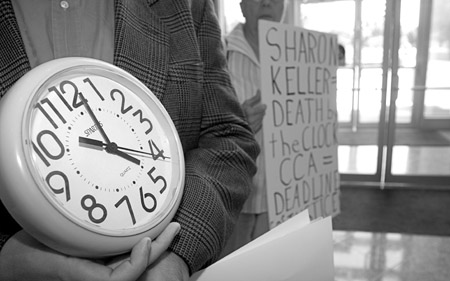
Killer Keller must resign


Photo by Jana Birchum
Published by The Daily Texan

"We close at five." It took these four words for Texas Court of Criminal Appeals Presiding Judge Sharon Keller to deny a convicted killer's last appeal. On September 25, the same day the U.S. Supreme Court granted a writ of certiorari to a Kansas inmate questioning the constitutionality of lethal injection, Michael Richard was scheduled to be executed. The attorneys for the Texas Defenders Service requested that the court clerk's office remain open 20 minutes after the 5 p.m. closing time because their computers had crashed. Keller shocked the world by closing the court's office at 5 p.m. on an execution day without even consulting any of the other judges of the court. As a result, a man was executed without being able to have the merits of his last appeal considered by the criminal justice system.

The Court of Criminal Appeals is the highest criminal court in Texas and must rule on every case before the U.S. Supreme Court can consider an appeal for a stay of execution. If the CCA had accepted the case and voted to deny Richard a stay, the U.S. Supreme Court could have issued a stay. That is exactly what happened in another case two days after Richard's execution, when the court voted 5-4 to deny a stay to Carlton Turner, but U.S. Supreme Court issued a stay of execution.

According to the Houston Chronicle, several judges were in the court while Keller turned down the appeal. Judge Paul Womack stayed as late as 7 p.m. expecting to receive a late filing. Judge Cheryl Johnson, who was the assigned judge to handle any late appeals, was not even informed, in Richard's case, of Keller's action until she read the story in the Austin American-Statesman.

"And I was angry," she told the Statesman. "If I'm in charge of the execution, I ought to have known about those things, and I ought to have been asked whether I was willing to stay late and accept those filings."

Keller's action denied Michael Richard two constitutional rights, access to the courts and due process, which led to his execution. Her actions also brought the integrity of the Texas judiciary system and of her court into question. But this is not the first time Keller has behaved like a buffoon. In 2000, she wrote the majority opinion in the case of Roy Criner, claiming that the new DNA evidence proving his innocence in a rape and murder case did not warrant a new trial because he could have "failed to ejaculate." According to Tom Price, one of the other conservative judges on the Texas Court of Criminal Appeals, as far back as 2001 she made Texas' highest criminal appeals court "a national laughingstock."

To close at 5 p.m. and refuse to accept an appeal by a person about to be executed is a violation of judicial responsibility. When a person is about to be executed, our state's highest criminal court needs to remain open for business. As long as Keller is in office, the people of Texas cannot be sure that justice is being done with integrity. Judge Sharon Keller should resign or be removed from office by the State Commission on Judicial Conduct, which is responsible for investigating allegations of judicial misconduct.

If you are as shocked as I was by Judge Sharon Keller's refusal to accept an appeal 20 minutes after 5 p.m. from lawyers representing a man about to be executed, then sign on to the general public complaint against Judge Sharon Keller by going to SharonKiller.com. The complaint will be submitted to the State Commission on Judicial Conduct on Oct. 30.

Hedayati is a government junior, Students Against the Death Penalty president and a Campus Progress at the Center for American Progress advisory board member.

Tuesday, October 09, 2007

National neglect and our death penalty struggle

Also in The Daily Texan

In August the nation saw the result of months of the Texas anti-death penalty movement's tireless work: the commutation of Kenneth Foster's death sentence, mere hours before his scheduled execution. In September the U.S. Supreme Court announced that it would take a Kentucky case to decide if the method of lethal injection used by many states, including Texas, constitutes cruel and unusual punishment. As a result, there could be a de facto moratorium on executions nation-wide, and possibly in Texas, until there is a ruling on this case. However, despite the recent successes at the Supreme Court and of the Kenneth Foster campaign, the Texas anti-death penalty movement is in troubling shape. Major foundations and national anti-death penalty leaders see Texas as a lost cause and are choosing not to fund a grassroots infrastructure here.

An enormous opportunity looms in Texas to actually achieve a moratorium on executions because of growing awareness that innocent people can be caught up in the system. But, lacking support on the national scale, Texas groups working to stop executions are not as well-equipped as they could be to take advantage of this ripe political moment.

The Kenneth Foster campaign taught us that organizing at the grassroots level works. Gov. Rick Perry would not have stopped Kenneth Foster's execution if there had been no public outrage concerning the planned death of a person who had not killed anyone. The group that played the biggest role in stopping Foster's execution was a student organization right here at UT: the Campaign to End the Death Penalty. In a thank-you letter after his commutation, Kenneth Foster wrote, "these people are gladiators when it comes to grassroots activism, and they definitely were the force behind this frontline."

The Texas nonprofit groups dedicated to abolishing the death penalty are run mainly by volunteers, and they lack funding and professional staff. There is not a single person in any grassroots anti-death penalty organization in Texas who is paid to work full-time. However, other states with far fewer executions than Texas have several full time staff members and much more funding.

Hundreds of thousands of dollars have been directed to fight the death penalty in states such as New York and New Jersey, where there have not even been any executions since the 1960s. If that kind of money could come to Texas, it would be much easier to put pressure on policymakers. A bill to create an Innocence Commission in Texas died last May in the House Criminal Jurisprudence Committee, and its failure to pass was a direct result of misplaced priorities by the national anti-death penalty movement.

The Tides Foundation's Death Penalty Mobilization Fund donated $50,000 last year to the Wisconsin Coalition Against the Death Penalty and $20,000 to Iowans Against the Death Penalty. What's wrong with this picture? Neither Wisconsin nor Iowa even has a death penalty. Wisconsin has not executed anyone since the mid-19th century. Meanwhile, five Texas executions were scheduled in September alone, and more than 400 people have been executed in Texas since 1982. Still, a group of several Texas anti-death penalty organizations applied to the same Tides funding program but received nothing.

The JEHT Foundation (Justice, Equality, Human dignity and Tolerance) gave a total of $542,400 to New Yorkers Against the Death Penalty from 2004 to 2006, but there hasn't been an execution in New York since 1963, and there is one person on that state's death row.

Working against the death penalty in Texas is not a lost cause, as working against segregation in Montgomery, Ala., was also not a lost cause during the civil rights movement in the 1960s. While Texas is ground zero in the fight to abolish the death penalty, we are making progress. But to continue this progress, the national anti-death penalty movement should invest more time and money in our state. How many lives could have been saved, as was Kenneth Foster's, if national campaigns channeled more funds into Texas over the last 10 years?