Saturday, October 20, 2007
CSI: East Lansing – science shows innocent man hanged in famous British murder case
On execution of Michael Dewayne Johnson
On October 19, 2006 my life would change in a drastic way. The truth of the matter is each day/month/year on death row changes me – even if only gradually like drops of water falling onto a rock. The change is there even if only seen by the most vigilant eyes.For me, when a date of execution is at hand I find myself, mentally and spiritually, in another place. I'm solemn and spacey, yet my senses are acutely aware that on this day someone will die. Premeditated murder is a hard adversary to face. In Texas it's become more like highway scenery, something that we see coming, passes us by quickly, but comes back again and again.
I have no balm, spell nor medicine to deal with this death ritual that induces pain, madness and horror. Truth, rage and fight is all I have. But the day of October 19, 2006 would be a day that would plunge me into a hell that I didn't know existed; a trauma that I didn't know I could feel. It would become a day that I would allow no one to ever forget.
The state-sanctioned murder of Michael Dewayne Johnson was scheduled to be carried out in the sadistic catacombs of the Criminal's Jest/us System. But instead of the glee that is System and its minions get from ushering a man to his murder, they would finally come face to face with a reflection of the horror of this process.
I would receive the news around 8am that in the middle of the night Michael Dewayne Johnson, instead of going to the gurney, chose to leave a lasting impression on all our minds, committing suicide by cutting his own throat with a razor. Like a 100-foot drop my stomach would plummet to depths of nausea that I didn't know existed and I felt that I would regurgitate up my entire being. In a state of shock I read those lines over and over again and each time it hit me harder and harder: "Suicide by cutting his own throat!" Dear God what has become?!?
For hours I would spiral out of sanity. Reports I got said the scene was unreal; thought to be macho and heartless, male officers were in tears and female officers were having nervous breakdowns. Blood would not only flood the floors, but it would also tell a story. Accounts vary, but it was said that in his own blood Michael Johnson wrote words declaring he didn't do the
crime, which right next to he posted a statement from his co-defendant who confessed to the crime. This is where I've made this event my personal business.
I knew Michael Johnson. I first met him in 1997 when I got to death row. Let me state for the record that Michael was NOT mentally ill. Michael was a highly intelligent man; the type of guy who might be a computer technician or an engineer. Michael was a very respectful person. He never caused anyone problems, he was always cordial, he recreated practically daily and he lived a peaceful life. He would help you if he could and something else many don't know is that not long before this tragic incident, Michael (in the face of critics and a bias prison setting built on black, white and brown separatist rules) embraced Islam, choosing the name Hamzaa for himself.
Outside of the reasons that this was a man of Peace and Kindness, whom the death penalty had to brutalize, I am making it my personal business to staunchly fly the flag of his name, but also for the reasons that he and I found ourselves bound to Death Row under the same means – The Law of Parties.
While in Michael's case there was a question raised on who shot the victim (unlike my case where the shooter admitted it) there was evidence (the statement that was said to be on the wall) that showed Michael's co-defendant admitting to the shooting. After stealing a car and joy riding, Michael and his friend went to a gas station to do a gas run (meaning fill up with gas and drive off), but when the gas attendant unexpectedly came out to approach them, acting on independent pulse, Michael's co-defendant shot the man and they drove off.
The combination of standing on his innocence of the crime of Capital Murder and his co-defendant quickly accepting a deal to shift blame, the state led Michael to death row. There are uncanny similarities between his case and mine. And due to the fact that I have passionately spoken out against this contradictive and unconstitutional law of parties for 10 years and having
those cries fall on deaf ears I am here to say that the anti-death penalty movement is failing us. It failed to know Michael Johnson and it is failing to be a force to save us from these horrors.
I'm here to make a powerful declaration – what Michael Dewayne Johnson did was not because he lived a suicidal life nor because he was mentally deranged, he did it to make a statement to YOU ("you" being all of you pro and anti-death penalty who think activism is monthly dues and meetings; yearly marches and speeches; but your work extends no further. Not into the
abyss of death row, not into the personal lives of death row inmates, not anywhere passed your own comfort zone). Genocide is not comfortable. Sensory deprivation housing is not comfortable.
The bloodthirsty cries of pro-death penalty people are not comfortable. When Michael Dewayne Johnson cut his own throat it was not comfortable nor made to make you feel comfortable. It was done to provoke you and make you remember how sick, demeaning and horrific death row is.
How does a man who never killed find himself on death row anyway? When is the anti-death penalty community going to start asking that question? I've begged and pleaded for 10 years for this anti-death penalty movement to do that, but now look. This is blood on your refusing hands. What has our movement become when it won't speak out for men they KNOW have not killed?
They'll speak out for sensationalized cases, cases where men have big backing, but for us no name people we find no favor in your sight. None of you knew Michael Dewayne Johnson, but may his name and plight now be forever burned in your psyche.
Do you think that Michael did this to avoid pain? NO WAY!! Michael is not the first to attempt suicide before his execution. He's not the first to commit suicide on Death Row. I wonder how many of you reading this is aware of that. Some of these men tried to go by pills, fire, cutting their wrists; and ones did go by hanging themselves. But to slice open your own neck is a
statement so potent that it brings tears to my eyes. It brings tears to my eyes because no one gave a damn to fight for this man.
I wonder what you all are doing at the sound of this news. Will it just be another event that you look at and say "That's so sad," or will you let this shocking event act as a fuel to attack this death penalty how it needs to
be?
I tell you that EVERY politician, TV and radio station in Texas needs to know what happened. They all need to see what their death row is, because that's been the reason we fail to bring change – these massacres have been made to seem too polite. Was the botched execution of the man in Ohio polite when needles were popping out of his arm? The people in this system don't
seem to care, because executions continue. Michael is dragged out and we prepare for the 6 other scheduled executions. This is a heartless killing machine that doesn't stop. What are we doing about it?
Then I have the additional unfortunate news to say that I – a man who has killed no one - awaits an execution date as my appeals proving my Innocence and that I'm not death eligible were denied. And I think strongly about Michael's statement. Why do we dignify the gurney? It has been successful in fooling the people in society that it's something humane and easy about this process. It's not! Thinking of all this I feel I'd rather die fighting, or at the end of a firing squad, the guillotine – let it be, in a fashion that exhibits what this country is really about: Systematic Genocide!
Are you going to put Michael Johnson in the back of your closet? Are you going to allow that statement to go unread by the world? Are you going to put myself and many others who have not killed anyone, against the horrors of the gurney and/or the razor?
I feel sad to say that I think you are, because I barely hear you and barely see you unless it's at the yearly galas. I think so because even in our own anti-death penalty movement there are people stealing from death row inmates, lying to their faces, blowing off their struggles because they don't have the fame or the fortune. And so where is Texas? At the bottom of the success and unity, and at the top of the executions. Have you thought to ask why? Why? Why? Why does a man find more solace in cutting his own throat than going to the gurney? I wonder if you'll have the courage to ask someone. Will you explore the depths of this hell? How long will you deny what this place is and what it's doing to men here, their families and society? The concept of politeness went out the door on October 19, 2006!
Now I'm left to the nightmares. I'm left with the burden to continue to find a way to smile, stay positive, sane and non violent. I'm left with people who are supposed to be advocates but they don't answer letters, make calls or visits. What is it going to take? Can we stand for anything more horrific than October 19, 2006? I fear to entertain the thought.
Men aren't walking to their executions in Texas. If you don't believe it go read:
www.drivemovement.org
Leave the illusion world of candles ending murder and signs stopping slaughters. If we're not putting forth Aggressive and Concerted Actions to deal with the systematic murders of people, then we will not make anymore progress than what we have seen.
Dear Michael,
I'm sorry that your fight was unheard. I'm sorry it was futile. I'm sorry that I've failed to get people to fight against the trash law of parties. I'm sorry that we are all being punished here like dogs. I'm sorry people lie to us and steal from us. But I promise you that I'll keep on keeping on. I promise that people won't forget the statement you made as long as I am alive, because we were bound by a common injustice.
Do people want change? I don't know, Michael. I do know DRIVE wants change! And I want your name forever in mind and I hereby mark October 19, 2006 as a day of Martyrdom for you. We will keep on fighting and I'm afraid that I may never see the Peace and Justice until the day that I see you. Until then........... The struggle continues.
--
Charles Perroud
"I have found that among its other benefits, giving liberates the soul of
the giver." - Maya Angelou
Thursday, October 18, 2007
Killer Keller must resign

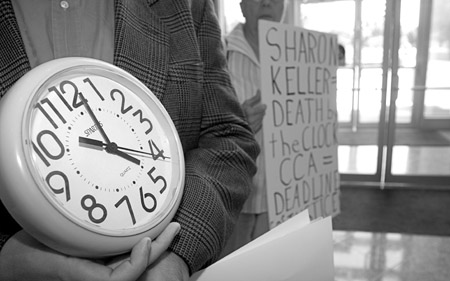
Photo by Jana Birchum
Published by The Daily Texan
"We close at five." It took these four words for Texas Court of Criminal Appeals Presiding Judge Sharon Keller to deny a convicted killer's last appeal. On September 25, the same day the U.S. Supreme Court granted a writ of certiorari to a Kansas inmate questioning the constitutionality of lethal injection, Michael Richard was scheduled to be executed. The attorneys for the Texas Defenders Service requested that the court clerk's office remain open 20 minutes after the 5 p.m. closing time because their computers had crashed. Keller shocked the world by closing the court's office at 5 p.m. on an execution day without even consulting any of the other judges of the court. As a result, a man was executed without being able to have the merits of his last appeal considered by the criminal justice system.
The Court of Criminal Appeals is the highest criminal court in Texas and must rule on every case before the U.S. Supreme Court can consider an appeal for a stay of execution. If the CCA had accepted the case and voted to deny Richard a stay, the U.S. Supreme Court could have issued a stay. That is exactly what happened in another case two days after Richard's execution, when the court voted 5-4 to deny a stay to Carlton Turner, but U.S. Supreme Court issued a stay of execution.
According to the Houston Chronicle, several judges were in the court while Keller turned down the appeal. Judge Paul Womack stayed as late as 7 p.m. expecting to receive a late filing. Judge Cheryl Johnson, who was the assigned judge to handle any late appeals, was not even informed, in Richard's case, of Keller's action until she read the story in the Austin American-Statesman.
"And I was angry," she told the Statesman. "If I'm in charge of the execution, I ought to have known about those things, and I ought to have been asked whether I was willing to stay late and accept those filings."
Keller's action denied Michael Richard two constitutional rights, access to the courts and due process, which led to his execution. Her actions also brought the integrity of the Texas judiciary system and of her court into question. But this is not the first time Keller has behaved like a buffoon. In 2000, she wrote the majority opinion in the case of Roy Criner, claiming that the new DNA evidence proving his innocence in a rape and murder case did not warrant a new trial because he could have "failed to ejaculate." According to Tom Price, one of the other conservative judges on the Texas Court of Criminal Appeals, as far back as 2001 she made Texas' highest criminal appeals court "a national laughingstock."
To close at 5 p.m. and refuse to accept an appeal by a person about to be executed is a violation of judicial responsibility. When a person is about to be executed, our state's highest criminal court needs to remain open for business. As long as Keller is in office, the people of Texas cannot be sure that justice is being done with integrity. Judge Sharon Keller should resign or be removed from office by the State Commission on Judicial Conduct, which is responsible for investigating allegations of judicial misconduct.
If you are as shocked as I was by Judge Sharon Keller's refusal to accept an appeal 20 minutes after 5 p.m. from lawyers representing a man about to be executed, then sign on to the general public complaint against Judge Sharon Keller by going to SharonKiller.com. The complaint will be submitted to the State Commission on Judicial Conduct on Oct. 30.
Hedayati is a government junior, Students Against the Death Penalty president and a Campus Progress at the Center for American Progress advisory board member.
Wednesday, October 17, 2007
Journey of Hope in Austin

SPEAK OUT AGAINST THE DEATH PENALTY!
WEDNESDAY OCTOBER 23 AT 12PM
ON THE TEXAS UNION PATIO AT UT
Every year the Journey of Hope travels the US speaking against capital punishment. This unique group of people is made up of murder victim family members, exonerated death row prisoners, and family members of death row prisoners. Come hear their stories!
Texas Journey of Hope...From Violence to Healing
October 13 - 27, www.journeyofhope.org
Tuesday, October 16, 2007
Houston Chronicle: Remove Sharon Keller from office
The events of Sept. 25 have put a stain on Texas justice that can only be cleansed by the removal of Chief Justice Sharon Keller from the Texas Court of Criminal Appeals.
On that day, Judge Keller let her personal bias in favor of the death penalty trample the right of now-executed prisoner Michael Richard to access the courts and have due process. In doing so, she abdicated her role as the state's chief criminal justice to become its chief executioner.
As laid out in a complaint to Texas' State Commission on Judicial Conduct signed by 20 distinguished Texas attorneys, including Houston's Dick DeGuerin and University of Houston Law Center professor Michael Olivas, Judge Keller's actions were legally inexcusable. The plot line could be straight from a Law and Order episode, with the twist that in this case it was the justice who committed the injustice.
After the U.S. Supreme Court agreed to consider a challenge to the constitutionality of lethal injection, attorneys for Richard, a convicted murderer, had less than a day to craft an appeal for a stay of execution pending resolution of the issue before the high court. A ruling by the Texas court was necessary before the U.S. Supreme Court could consider his appeal.
Because of computer problems, Richard's lawyers requested that the Court of Criminal Appeals remain open past 5 p.m. to take the last-minute appeal. The judge assigned to the case, Cheryl Johnson, and two other judges had stayed late, anticipating that an appeal might be forthcoming before the execution scheduled later that evening. Without informing them of her decision, Judge Keller refused to allow the appeal to be filed after 5 p.m. Richard was executed hours later.
Even Keller's court colleagues expressed dismay at her actions. Justice Johnson was quoted in the complaint as angry, because "if I'm in charge of the execution, I ought to have known about these things, and I ought to have been asked whether I was willing to stay late and accept those filings." She indicated she would have accepted the brief, "because this is a death case." Justice Paul Womack told the Chronicle he waited in his office till 7 p.m. because "it was reasonable to expect an effort would be made in some haste in light of the Supreme Court. I wanted to be sure to be available in case it was raised."
Justice Keller's response to the uproar was that the lawyers should have filed the appeal on time. After all, she said, "they had all day." When an irreversible action like an execution is only hours away from occurring, Keller's adherence to a 9 a.m.-to-5 p.m. justice schedule is mind boggling. Civil judges are available at all hours to sign temporary restraining orders as are criminal judges to approve search warrants. Yet in the taking of a life, the most profound action a judge will ever be involved in, Keller wants to stick to banker's hours.
The irresponsibility of Keller's behavior was highlighted by subsequent legal developments. Two days after the Richard execution, the Supreme Court stayed the execution of another Texas prisoner, Carlton Turner. Although his appeal had been denied by the Texas court, the fact that it was heard allowed the high court to act.
Then the Court of Criminal Appeals stayed the scheduled execution of convicted murderer Heliberto Chi, effectively signaling a halt to death by injection in the state until the high court rules on its constitutionality.
Just as Turner and Chi were spared pending the resolution of the issue, so Michael Richard should be alive today. Since she will not face the voters until 2012, the miscarriage of justice perpetrated by Chief Justice Keller can only be remedied by a recommendation by the Judicial Conduct Commission to the Texas Supreme Court that she be removed from office.
Rep. Lon Burnam files a complaint against Judge Sharon Keller
LON BURNAM
DISTRICT 90 • FORT WORTH
October 15, 2007
State Commission on Judicial Conduct
PO Box 12265
Austin, TX 78711
Dear Members of the Commission:
I am writing to file a complaint with the Commission concerning the actions of Judge Sharon Keller, Presiding Judge of the Texas Court of Criminal Appeals, on the evening of September 25. According to several news accounts, Judge Keller refused to keep her office open later than 5pm to receive the pleading of Michael Richard who was killed by lethal injection later that night. It is my opinion that her actions were unprofessional and unethical and constitute judicial misconduct. I urge you to take prompt and appropriate disciplinary action against Judge Keller, which should include serious consideration of removal from office.
Judge Keller’s actions resulted in the loss of constitutional rights of Mr. Richard. Further, her actions have embarrassed the state of Texas and cast severe doubt on the impartiality of the Court of Criminal Appeals. The public’s perception of the fairness of the courts is vital to the maintenance of the rule of law. If disciplinary action is not taken against Judge Keller, thisperception will be irreparably harmed.
It is simply unconscionable and unacceptable for any officer of the court to close the doors of the court when a pleading for a man’s life is known to be on the way. I urge you to take swift and decisive action to repair the damage done by Judge Keller to the integrity of Texas courts.
Sincerely,
Lon Burnam
Sunday, October 14, 2007
Sign on to the general public members' Judicial Complaint Against Judge Sharon Keller
If you are as shocked as we were by the refusal of Judge Sharon Keller to accept an appeal 20 minutes after 5 PM by lawyers representing a man about to be executed, then sign on to this complaint. We will submit this complaint to the State Commission on Judicial Conduct on October 30, 2007. In order for your name to count on the complaint for the submission, you must provide all the requested contact information, including your phone number and occupation. Anyone can sign on to the complaint. It is intended as a means for regular members of the public to express their outrage at Keller's action.We must also have your signature, so download the signature form PDF version , MS Word version and fax it to ![]()

![]()
![]()
![]()
+15124028428
or mail it to Scott Cobb at 3616 Far West Blvd, Suite 117, Box 251, Austin, Texas 78731. If you would like to download a copy of the complaint for your records, click here
Saturday, October 13, 2007
Statesman bashes Sharon Keller
By The Editorial Board | Saturday, October 13, 2007
Sharon Keller, presiding judge of the Texas Court of Criminal Appeals, has never shown much sympathy toward death row inmates.
Keller and this state’s highest court for criminal cases have a well-earned reputation for tolerating egregious abuses in capital trials and appeals. Their record of indifference to the right to effective defense counsel and for judicial precedent has put them at odds with the U.S. Supreme Court numerous times.
Texas executes more inmates than any other state by far, and too many of those condemned men and women had poor legal representation from the initial trial through the final appeal. Keller’s court has consistently failed in its duty to ensure the integrity of capital trials and death sentences.
One of the most appalling examples of Keller’s judicial philosophy was her refusal to accept an appeal from condemned prisoner Michael Richard on Sept. 25. Keller wouldn’t keep the court open past 5 p.m. to receive Richard’s appeal, and she didn’t inform other judges working late about the request. Richard was executed that night.
That cold-hearted response drew international criticism of Keller and the court. It was particularly outrageous because the U.S. Supreme Court had earlier that day accepted a death penalty appeal challenging the constitutionality of lethal injections, used by Texas and other states.
Last week, Keller’s “We close at 5” response resulted in an ethics complaint filed with the State Commission on Judicial Conduct by 19 Texas lawyers. The complaint came from some highly respected attorneys, including Austin lawyers James George Jr., Broadus Spivey and Chuck Herring Jr.
They are asking the commission to remove Keller from office, or otherwise discipline her, for violating the Texas Code of Judicial Conduct. The complaints are firmly grounded and the commission should give them careful consideration.
The judicial canons themselves are subjective - judges must preserve the integrity of the judiciary and promote public confidence in judicial integrity, for instance. Most lawyers can argue about that wording as long as they can draw breath.
But whatever the commission decides, it is abundantly clear that Keller and her court have been more concerned with process than justice. They have repeatedly ignored the fundamental right of a defendant to competent counsel. Reporting by the American-Statesman’s Chuck Lindell has highlighted the court’s indifference to glaringly inept defense attorneys in capital cases.
Keller’s coldblooded response in the Richard case may have been the last straw that prompted the ethical complaint, but the appeals court has been grating on legal sensibilities for years.
Finally, an important part of the legal community said it has had enough and moved to have Keller disciplined, and possibly removed from the bench. That is an important step in guarding the integrity of criminal justice in Texas.
Friday, October 12, 2007
Youth Summit on the Death Penalty
Courtney 832-704-8900
Al Gore and IPCC share the 2007 Noble Peace Prize
Wednesday, October 10, 2007
Mark White and Jim Mattox criticize Greg Abbott
Keller. a Republican, was not the only state elected official criticized Wednesday in connection with the Richard execution.Former Gov. Mark White and former Attorney General Jim Mattox, who both fought to enforce the state's capital punishment laws during their terms as attorney general, said Abbott, as the state's top lawyer, has a duty to halt executions when they appear to violate an inmate's due process rights.
White said Abbott is an officer of the court and he "should have been obligated to ask for a stay" in the Richard execution.
Mattox said the attorney general may lack actual legal authority to stop an execution, but the state prison system will follow an attorney general's order.
Mattox, who witnessed more than 30 executions, said he once ordered an inmate off the execution gurney over prison system protests because he knew the man would receive a stay.
"When the state is all powerful, the state has got to be cautious in how it uses its power," he said. "Sometimes you do things not to protect the individual but to protect the system itself."
Lawyers file complaint over court closure in death case
AUSTIN — Twenty lawyers from across Texas today filed a formal judicial conduct complaint against Texas Court of Criminal Appeals Presiding Judge Sharon Keller, accusing her of violating the constitutional due process of a condemned man.The complaint to the State Commission on Judicial Conduct says Keller improperly cut off appeals that led to the execution of Michael Richard on Sept. 25 despite the fact the U.S. Supreme Court earlier in the day had accepted a case on the propriety of lethal injection, which had direct implications for Richard's execution.
"Judge Keller's actions denied Michael Richard two constitutional rights, access to the courts and due process, which led to his execution," the complaint states. "Her actions also brought the integrity of the Texas judiciary and of her court into disrepute and was a source of scandal to the citizens of the state."
Those lawyers signing the complaint included former State Bar President Broadus Spivey, Houston criminal defense lawyer Dick DeGuerin, University of Houston law professor Mike Olivas, former appellate Judge Michol O'Connor, state Rep. Harold Dutton, D-Houston, and former Nueces County Attorney Mike Westergren.
The lawyers are being represented in the complaint by Jim Harrington, director of the Texas Civil Rights Project. Harrington said Keller's actions were "morally callous, shocking and unconscionable for an appellate judge."
The commission's proceedings are secret. At the end, the commission can dismiss a complaint without making it public; publicly reprimand a judge or recommend to the Texas Supreme Court that the judge be removed from office.
At issue is the sequence of events leading up to the execution of Richard, 49, for the 1986 rape and fatal shooting of Marguerite Dixon, a Hockley mother of seven.
Lawyers for Richard had called the court's clerk, asking that the office stay open an extra 20 minutes so a stay of execution request could be filed. Even if it was denied by the state court, that request was procedurally necessary to get a stay from the Supreme Court.
Keller last week voiced no second thoughts about her actions.
"You're asking me whether something different would have happened if we had stayed open," Keller said, "and I think the question ought to be why didn't they file something on time? They had all day."
Although other judges at the Texas appeals court were waiting for Richard's appeal, Keller ordered the clerk to close promptly at 5 p.m. Because of that, Richard's appeal was not filed and he was executed later in the evening.
Judge Cheryl Johnson was the appeals court jurist in charge of Richard's case. She said she never heard anything about the clerk's office closing off the appeal until the following day.
"I wasn't consulted," Johnson said. "I have been here almost nine years. My understanding was that on a death case we were here up until the time of the execution and we would take filings that came in up until 6 o'clock and the execution is underway."
Johnson said it is not a question of whether Richard is guilty but did he have the right to appeal.
r.g.ratcliffe@chron.com
Tuesday, October 09, 2007
RODNEY REED: Rally in Bastrop, Texas
RODNEY REED: INNOCENT ON TEXAS DEATH ROW! Gather with Rodney's family and friends for and evening of solidarity and struggle. WITH AUSTIN BAND DIASPORIC! Starting with a march through Bastrop, followed by music & spoken word, and ending with a screening of the documentary State vs Reed. With food and drink.
NEW TRIAL NOW! NO EXECUTION!
SATURDAY, OCTOBER 13TH
STARTING AT 3 PM
KERR COMMUNITY PARK
AT MLK AND WALNUT
To carpool from Austin, meet at 1:30PM in the LBJ Parking Lot. Off Red River between Manor and Dean Keeton.
To drive from Austin take I-35 South and take Hwy 71 East toward Bastrop. About 25 miles. Take the Hasler/Childers and Loop 150 exit. Take a left at the second light (Loop 150). Go through downtown Bastrop and after you cross the railroad tracks, take a right on Martin Luther King. Go one block and take a right on Walnut to park.
SPONSORED BY THE CAMPAIGN TO END THE DEATH PENALTY
For more info contact 512-494-0667 or cedpaustin@gmail.com
www.freerodneyreed.org
Reserve on Facebook
National neglect and our death penalty struggle
In August the nation saw the result of months of the Texas anti-death penalty movement's tireless work: the commutation of Kenneth Foster's death sentence, mere hours before his scheduled execution. In September the U.S. Supreme Court announced that it would take a Kentucky case to decide if the method of lethal injection used by many states, including Texas, constitutes cruel and unusual punishment. As a result, there could be a de facto moratorium on executions nation-wide, and possibly in Texas, until there is a ruling on this case. However, despite the recent successes at the Supreme Court and of the Kenneth Foster campaign, the Texas anti-death penalty movement is in troubling shape. Major foundations and national anti-death penalty leaders see Texas as a lost cause and are choosing not to fund a grassroots infrastructure here.
An enormous opportunity looms in Texas to actually achieve a moratorium on executions because of growing awareness that innocent people can be caught up in the system. But, lacking support on the national scale, Texas groups working to stop executions are not as well-equipped as they could be to take advantage of this ripe political moment.
The Kenneth Foster campaign taught us that organizing at the grassroots level works. Gov. Rick Perry would not have stopped Kenneth Foster's execution if there had been no public outrage concerning the planned death of a person who had not killed anyone. The group that played the biggest role in stopping Foster's execution was a student organization right here at UT: the Campaign to End the Death Penalty. In a thank-you letter after his commutation, Kenneth Foster wrote, "these people are gladiators when it comes to grassroots activism, and they definitely were the force behind this frontline."
The Texas nonprofit groups dedicated to abolishing the death penalty are run mainly by volunteers, and they lack funding and professional staff. There is not a single person in any grassroots anti-death penalty organization in Texas who is paid to work full-time. However, other states with far fewer executions than Texas have several full time staff members and much more funding.
Hundreds of thousands of dollars have been directed to fight the death penalty in states such as New York and New Jersey, where there have not even been any executions since the 1960s. If that kind of money could come to Texas, it would be much easier to put pressure on policymakers. A bill to create an Innocence Commission in Texas died last May in the House Criminal Jurisprudence Committee, and its failure to pass was a direct result of misplaced priorities by the national anti-death penalty movement.
The Tides Foundation's Death Penalty Mobilization Fund donated $50,000 last year to the Wisconsin Coalition Against the Death Penalty and $20,000 to Iowans Against the Death Penalty. What's wrong with this picture? Neither Wisconsin nor Iowa even has a death penalty. Wisconsin has not executed anyone since the mid-19th century. Meanwhile, five Texas executions were scheduled in September alone, and more than 400 people have been executed in Texas since 1982. Still, a group of several Texas anti-death penalty organizations applied to the same Tides funding program but received nothing.
The JEHT Foundation (Justice, Equality, Human dignity and Tolerance) gave a total of $542,400 to New Yorkers Against the Death Penalty from 2004 to 2006, but there hasn't been an execution in New York since 1963, and there is one person on that state's death row.
Working against the death penalty in Texas is not a lost cause, as working against segregation in Montgomery, Ala., was also not a lost cause during the civil rights movement in the 1960s. While Texas is ground zero in the fight to abolish the death penalty, we are making progress. But to continue this progress, the national anti-death penalty movement should invest more time and money in our state. How many lives could have been saved, as was Kenneth Foster's, if national campaigns channeled more funds into Texas over the last 10 years?
Monday, October 08, 2007
Sharon Keller's Action Shows How Death Penalty is Haphazard, Capricious
The Boston Globe notes in an editorial today entitled "Always Cruel and Unusual" that Michael Richard
was executed Sept. 25 - the very day the Supreme Court decided to hear the lethal injection arguments - because the Texas court had closed for business.
The haphazard, capricious way the legal system decides who lives or dies violates fundamental American principles of fair and equal justice. The Supreme Court already has said that "evolving standards of decency" will guide its thinking in capital punishment cases. Lethal injection, and the death penalty itself, both fail the test of decency.
Sunday, October 07, 2007
Things to remember about executions
Remember the names Michael Richard and Carlton Turner.
One is dead; one is alive.
Both had been given the death penalty in Texas and were scheduled to die within two days of each other last month.
Again, one is dead; one is alive.
Their cases once again prove the arbitrariness of the death penalty in Texas and the pure absurdity of capital punishment in the United States.
While you concentrate on those two names -- Michael Richard and Carlton Turner -- also remember the name of Sharon Keller, presiding judge of the Texas Court of Criminal Appeals.
Keller proves how unjust (or at the very least how insensitive) the highest criminal court in the state can be.
And once again, Lady Justice ought to be hiding her head in shame in the Lone Star State.
The U.S. Supreme Court announced Sept. 25 that it would take a Kentucky case to decide if the method of lethal injection used by many states, including Texas, constitutes cruel and unusual punishment.
It seemed only natural that states that use that form of punishment would call a moratorium on executions until the high court rules on the matter. But not Texas, which already had put 26 people to death this year.
On the very evening of the Supreme Court's announcement, the state executed Richard after one of the most surreal actions by an appeals court justice that one could imagine.
Richard's lawyers were busy preparing an appeal for their client when their computer crashed late that afternoon. They called the Texas Court of Criminal Appeals, explained the problem and requested that the court stay open long enough for them to file the motion, according to The Associated Press.
"We close at 5," Keller responded, according to the Austin American-Statesman.
"I got on a phone call shortly before 5 and was told that the defendant had asked us to stay open. I asked why, and no reason was given," the judge told the newspaper.
It already was close to 5 p.m., so there was no time for the attorneys to meet that deadline.
Keller reportedly made her decision without consulting any other judge -- and at least three were still in the building after 5 p.m. that day -- and not bothering to inform the one judge who was assigned to review Richard's case.
Judge Cheryl Johnson, who was assigned to handle Richard's motions, was quoted as being very angry that she had not been notified that the chief judge basically was locking the doors on a case in which attorneys were trying to file a last-minute appeal.
The Texas appeals court didn't rule on the case at all that evening, so the Supreme Court couldn't step in and issue a stay of execution for Richard.
The state killed him.
Two days later, however, after the Texas court had refused to grant a stay in Turner's case, the Supreme Court stopped his execution that Thursday evening. Turner, who had admitted killing his parents in Irving in 1988, was lucky that his appeal got to Austin before the doors closed at 5.
Last week, the Court of Criminal Appeals did grant a stay for another Death Row inmate, Heliberto Chi, convicted of the 2001 murder of an Arlington man. He was set to be executed Wednesday.
This execution business is out of whack in Texas. Killing a man in the name of the state should not depend on luck or an impatient appeals judge who is more interested in when the courthouse closes than in an individual's life.
Texas has three other executions scheduled between now and Feb. 21. I can only presume that those will not be carried out. Based on the state appeals court's action in Chi's case and the Supreme Court's action in Turner's case, I hope that we have at least a de facto moratorium on executions --for a little while, anyway.
Keep in mind that the issue the Supreme Court will consider is not abolishing capital punishment, but whether one method of execution is unconstitutionally cruel.
After the court rules, Texas will be back in the killing business again, I assure you -- unless we demand that our politicians end this immoral act altogether.
It is long past time to put a stop to this insanity.
If you still have doubts about that, just remember those two names: Michael Richard and Carlton Turner. Remember, too, Judge Sharon Keller.
And as you contemplate the judge's name, also remember that members of the Texas Court of Criminal Appeals are elected.
bobray@star-telegram.com
Bob Ray Sanders' column appears Sundays and Wednesdays. 817-390-7775
Saturday, October 06, 2007
Dems Dance Around Death Penalty
By Liliana SeguraThe Indypendent
When presidential hopeful John Edwards scanned the audience at the start of his session at the YearlyKos Convention in July, one woman looked particularly eager. Presented with the rare opportunity to ask the Democratic candidate a tough question on his credentials for office, Judy from Portland had a more pressing concern.
“Did you get the cookies?”
A pause.
“Yes!” Edwards exclaimed. “We did!”
Judy beamed.
“Is that your question?” Edwards asked, smiling.
It was. People clapped.
It was the perfect example of the candidates’ treatment at YearlyKos — that ballyhooed gathering of “progressive” bloggers, media mavens and political operatives who laud the “netroots” for their influence on electoral politics. That the leading Democratic candidates showed up at the conference at all was a source of ceaseless celebration — and most people were too busy reveling to confront them with hard questions. From the panel “debate” (during which audience members sang “Happy Birthday” to Barack Obama) to the individual breakout sessions (stocked with colorful candidate propaganda), the atmosphere was more pep rally than firing line.
But I had a question, and it wasn’t about cookies. I wanted to confront the candidates on the death penalty.
It didn’t matter which one. Quietly, but without exception, all the leading Democrats vying for the presidential nomination support capital punishment. Products of a political era that saw Michael Dukakis pilloried on the issue in 1988, the Democrats have aligned themselves with their rivals across the aisle. Third parties aside, the last four presidential elections have left voters with a choice of two death penalty supporters.
That this will be true in 2008 would be less surprising if it were not for the seismic shifts that have occurred with the death penalty. The past few years have seen the Supreme Court outlaw the execution of the mentally retarded and prisoners convicted as juveniles, while exonerations increase across the country and executions drop to historic lows. Lethal injection is under fire as being demonstrably cruel, and moratoriums have stalled the death machinery in several states.
Most recently, the U.S. attorneys scandal shed light on the Bush administration’ s push to expand the federal death penalty over the objections of its own prosecutors. Despite all of this, discussion of the death penalty was off the table at YearlyKos, as it was in the major debates.
At the conference, many people were surprised to discover the candidates’ positions. “Even Obama?” was a common response. Yes, even Obama supports the death penalty in cases “so heinous … that the community is justified in expressing the full measure of its outrage,” as he wrote in his bestseller, The Audacity of Hope. It’s a disingenuous statement, designed to score political points. The communities most affected by violent crime are rarely the ones invited to “express their outrage.” Instead, they bear the brunt of the criminal justice system’s cruelest excesses.
I was not able to get near him, but I knew what I would have asked. “As a former community organizer on the South Side of Chicago, surely you are aware of the innocent black men who spent years on death row after being tortured by Chicago police into confessing to crimes they didn’t commit?” Hillary Clinton’s “breakout session” (read: campaign rally) was packed, tightly managed and stacked with fresh-faced campaign volunteers. My hand was ignored.
Not surprisingly, no one asked why the former First Lady had spent the mid-1990s lobbying for legislation that drastically expanded the number of crimes eligible for the federal death penalty while curbing death penalty appeals.
Then there was Edwards. More than any other candidate, his rhetoric that day reeked with hypocrisy when placed alongside his support for the death penalty. Calling the Democrats “the party of the people,” he repeatedly invoked poverty and torture; now he was listening to an atheist argue that his religious rhetoric was isolating America’s nonbelievers. In fact, Edwards replied soberly, more than anything, “morality” was central to his political vocabulary.
A few minutes later, he called on me.
I introduced myself.
“I heard you talk about torture in the larger session and you talk about ‘two Americas’ and being for the poor. So I want to know why you continue to support the death penalty … which disproportionately targets the poor, which disproportionately affects people of color, which condemns the innocent to die and which is basically immoral.”
At length and brimming with Clintonian empathy, Edwards responded. He plucked a trite hypothetical, “If a person … murders a five-year-old …” to a smattering of boos. “You don’t have to agree with me!” he exclaimed. When he was done, few people clapped.
Maybe the Dems do not want to talk about the death penalty, because in their hearts they know it is morally indefensible. More likely, they know that as long as no one holds them accountable, it is a political stance that costs them nothing. It’s their “soft on crime” trump card.
It is time to call this out. From the war to the domestic killing machine, the Democrats have proven themselves little more than a loyal opposition. As long as there are people facing execution across this country, there should be no more birthday serenades or cookie baking for political celebrities.
For the prisoners and their families, the stakes are too high.
Friday, October 05, 2007
Kinky Friedman on CNN's Situation Room
Texas Civil Rights Project might also file a complaint against Judge Sharon Keller
David Dow, an attorney in the case who runs the Texas Innocence Network at the University of Houston Law Center, called her statement "outrageous," noting that lawyers had to decide legal strategy and then craft a filing about why the case before the U.S. Supreme Court applied to Richard's arguments.
The reason behind the request for the delay was a severe computer problem, Dow said. He said he told the court clerk about the problem. Keller said the lawyers didn't give a reason.
Dow also said the court will not accept a filing by e-mail. If it did, he said, lawyers could have met the 5 p.m. deadline once they beat their computer problem, because printing the filing took extra time. The lawyers needed about another 20 minutes.
Jim Harrington, director of the Texas Civil Rights Project, said he was thinking about filing a complaint with the Texas State Commission on Judicial Conduct about Keller.
"When I saw that, I think I would just describe my reaction as 'stunningly unconscionable,' " Harrington said of her refusal. "There has to be some kind of accountability for this."
Seana Willing, executive director of the Texas commission, said she isn't sure Keller could be sanctioned, were a complaint to be filed, because she isn't aware of anything in the Code of Judicial Conduct that would cover her decision to close the clerk's office while a death penalty case was pending. She indicated she looked through the code after learning of the dispute but could find "nothing specific" dealing with it.
Keller, who was re-elected last year to a six-year term, and Cochran also said they couldn't think of a provision that Keller's action would violate. Judge Mike Keasler, noting he teaches judicial ethics, said he knows of no violation related to such an administrative action by the court's presiding judge.
Harrington said, "I think you'd take the totality of it and have to make some sort of argument this was a gross miscarriage of justice."
Lawyers said that without a ruling by the Texas Court of Criminal Appeals on Richard's appeal, the U.S. Supreme Court couldn't consider it. The U.S. Supreme Court stayed another man's execution the same week, after his appeal was denied by the Court of Criminal Appeals.
Thursday, October 04, 2007
Commission on Judicial Conduct should investigate Judge Sharon keller
Texas Court of Criminal Appeals Presiding Judge Sharon Keller closed thecourt's office at 5 PM on an execution day without consulting any of the
other judges on the court. As a result, a man was executed without being
able to have the merits of his last appeal considered by the justice system. To close at 5 PM and refuse to accept an appeal by a person about to be executed is a violation of judicial responsibility. When a person is about to be executed, our state's highest criminal court needs to remain open for business. Keller should resign or be impeached and removed from office for her unethical conduct. This is not the first time that Keller has behaved like a buffoon. According to Tom Price, one of the other conservative judges on the Texas Court of Criminal Appeals, as far back as 2001 she made Texas' highest criminal appeals court "a national laughingstock." As long as Keller is in office, the people of Texas can not be sure that justice is being done with integrity.
Any concerned Texan can file a complaint with the State Commission on Judicial Conduct by going to: www.scjc.state.tx.us
Wednesday, October 03, 2007
Judge Sharon killer must resign!
It was revealed Tuesday that the decision was made by Presiding Judge Sharon Keller without consulting any of the court's eight other judges or later informing them about the decision — including Judge Cheryl Johnson, who was assigned to handle any late motions in Richard's case.Johnson, who learned about the request to stay open past 5 p.m. in an Austin American-Statesman story, said her first reaction to the news was "utter dismay."
"And I was angry," she said. "If I'm in charge of the execution, I ought to have known about those things, and I ought to have been asked whether I was willing to stay late and accept those filings."
Johnson said she would have accepted the brief for consideration by the court. "Sure," she said. "I mean, this is a death case."
Judge Cathy Cochran said the Richard case raised troubling questions.
"First off, was justice done in the Richard case? And secondly, will the public perceive that justice was done and agree that justice was done?" Cochran said. "Our courts should be open to always redress a true wrong, and as speedily as possible. That's what courts exist for."
At least three judges were working late in the courthouse that evening, and others were available by phone if needed, court personnel said.
None of the judges was informed of Richard's request by Keller or by the court's general counsel, Edward Marty, who had consulted with Keller on the request.
Keller defended her actions, saying she was relating the court's longstanding practice to close on time.
"I got a phone call shortly before 5 and was told that the defendant had asked us to stay open. I asked why, and no reason was given," Keller said. "And I know that that is not what other people have said, but that's the truth. They did not tell us they had computer failure.
"And given the late request, and with no reason given, I just said, 'We close at 5.' I didn't really think of it as a decision as much as a statement," Keller said.
Keilen, whose organization also handled Richard's appeal, said court clerks were informed about the computer problems.
The clerk's office, asked whether Keller was told of the malfunction, referred questions to Judge Tom Price, who is in charge of court personnel. Price did not respond, and calls to other judges were not returned Tuesday.
Tuesday, October 02, 2007
We Close at 5
What's 20 minutes to you? Two miles on the expressway during rush hour? Time to slurp a latte on the way back to the office? About the time it takes to scan the newspaper you're reading now? To Michael Richard, 20 minutes was probably the difference between life and death.
The Texas death-row inmate's lawyers petitioned for a stay of execution after the U.S. Supreme Court's decision to review the constitutionality of lethal injection. Irving killer Carlton Akee Turner won a last-minute stay from the high court. Mr. Richard's lawyers were working on his petition when their computer crashed. They phoned the Texas Court of Criminal Appeals, informed its personnel of the computer problems and asked them to stay open long enough to accept the paperwork.
Forget it, replied the court. Time thus ran out for Mr. Richard, who died on the gurney. A court official later said, "I advised the parties that called that we closed at 5." Just like that.
That is unconscionable.
You might not lose sleep over the fact that the court wouldn't stay open for 20 minutes to help a convicted rapist-murderer's attempt to evade the needle a bit longer. You should think again.
When the state takes the life of a condemned criminal, it must do so with a sense of sobriety commensurate with its grave responsibility. Hastening the death of a man, even a bad one, because office personnel couldn't be bothered to bend bureaucratic procedure was a breathtakingly petty act and evinced a relish for death that makes the blood of decent people run cold.
Appeals court halts execution of Honduran man
execution Wednesday of a Honduran man and asked for the prison system to
respond in writing as to whether lethal injection is unconstitutionally
cruel.
Heliberto Chi, 28, was convicted in the 2001 killing of an Arlington store
manager. His appeal was partly based on the U.S. Supreme Court's decision
last week to study whether lethal injection in Kentucky which uses the
same 3-drug combination as in Texas violated the Eighth Amendment.
The breakdown of the court's vote was not immediately available. Earlier
today, the Texas Board of Pardons and Paroles voted 4-3 not to grant Chi a
6-month stay.
(source: Houston Chronicle)
Monday, October 01, 2007
Nueces D.A. won't seek death penalty while Supreme Court has yet to rule
By Mary Ann Cavazos (Contact)
Monday, October 1, 2007
CORPUS CHRISTI — The Nueces County District Attorney’s Office put a hold on seeking the death penalty in capital murder cases on Monday in light of the Supreme Court’s decision last week to hear a case that questions whether lethal injection is cruel and unusual punishment.
Under Texas law, capital murder carries only two possible sentences: death or life in prison without parole.
“Until we can get some direction from the Supreme Court, we will waive the death penalty and seek life in prison, which is the only other punishment allowed,” District Attorney Carlos Valdez said.
The case, which will be heard by the high court early next year, was filed by two inmates on death row in Kentucky who claim that lethal injection is inhumane and violates the Eighth Amendment.
The local self-imposed moratorium, which took effect Monday, will not affect any of the county’s pending capital murder cases because the office already had decided not to seek the death penalty.
Assistant District Attorney Mark Skurka said it also won’t affect the cases of four Nueces County men on death row for capital murder but is more of a precautionary measure.
Most states that allow the death penalty use lethal injection to put inmates to death. But at least six states have halted executions because of issues surrounding the method, which uses a combination of anesthetic, muscle paralyzer and a substance to stop the heart.
So far this year, 42 people have been executed in the country. Texas, which has put 26 inmates to death by lethal injection, leads with the most executions.
The Associated Press contributed to this report.
Atlanta Journal Constitution: Death penalty unfair, must be abolished
Georgia's death penalty law can and should be updated to try to wring as much unfairness as possible from the system, but reform can never eradicate the possibility of error, and it can never remove human bias and prejudice from the process. Imposing the absolute penalty requires absolute justice, and in the absence of that, the death penalty ought to be abolished.
New trial for Robert Fratta
Although U.S. District Judge Melinda Harmon granted the trial without comment, attorneys for Robert Fratta based his appeal on what they said was an inadmissible jailhouse confession by the trigger man that factored into the jury's decision to convict Fratta.
Fratta was convicted in the 1994 murder-for-hire of his wife, Farah, then 33. During the 1996 trial, the evidence against Fratta included a confession from Howard Guidry, whom prosecutors said was the gunman.
In the appeal, Fratta's attorneys argued that an investigator with the Harris County Sheriff's Office had tricked Guidry into confessing. They alleged that Guidry had not been allowed see his attorney during interrogation, even after he demanded that he be allowed to do so.
At one point, the investigator left the interrogation room, then returned saying he had spoken with Guidry's lawyer, and that the attorney had given Guidry permission to speak to police. Guidry then confessed. Guidry's attorney later said he had never been contacted by the investigator.
Guidry was convicted and sentenced to death. In 2006, he was granted a new trial, but later convicted a second time.
Prosecutors contend that Fratta had his wife killed after she filed for divorce following his bizarre sexual desires. He also tried to collect on his wife's $235,000 life insurance policy days after her death.
Council of Europe Secretary General on the refusal to end lethal Injections in Texas
Strasbourg, 01.10.2007 - The authorities in Texas are showing an incredible disregard for human lives as well as for the United States Supreme Court. Last week several US states halted executions pending the examination of the constitutionality of lethal injections by the US Supreme Court, but the Attorney General of Texas seems unperturbed, and several scheduled executions, including one this week, may well be carried out. Texas' penchant for executions is notorious, but this latest development is breaching yet another legal and moral boundary.Meanwhile, we should all be encouraged by the fact that the US
Supreme Court will look into whether poisoning a human being to death
is cruel. Personally, I hope that the Justices will conclude that a
lethal injection violates the Eight Amendment's ban on cruel and
unusual punishment. It should help the United States of America to
catch up with the majority of civilised and democratic countries in
the world which no longer execute people.
Le Secrétaire Général du Conseil de l'Europe dénonce le refus du
Texas de mettre fin aux injections létales
Strasbourg, 01.10.2007 - Les autorités du Texas font preuve d'un
mépris incroyable à l'égard de la vie humaine et de la Cour suprême
des Etats-Unis. La semaine dernière, plusieurs Etats américains ont
suspendu les exécutions en attendant la décision de la Cour suprême
sur le recours constitutionnel concernant les injections létales,
mais le procureur général du Texas ne semble pas s'en émouvoir, si
bien que plusieurs exécutions prévues, dont une cette semaine,
pourraient avoir lieu. La tendance du Texas à recourir à la peine
capitale est tristement célèbre, mais ce dernier fait nouveau viole
une limite juridique et morale de plus.
Dans l'intervalle, nous devrions tous nous sentir encouragés par le
fait que la Cour suprême des Etats-Unis se demande s'il est cruel
d'empoisonner un être humain pour le mettre à mort. Personnellement,
j'espère que les juges concluront que l'injection létale viole
l'interdiction des peines cruelles et extraordinaires, consacrée par
le Huitième amendement. Cela aiderait les Etats-Unis à rejoindre le
groupe important de pays civilisés et démocratiques du monde qui ont
aboli la peine de mort.